Pause the current song to play another preview

All the streams. Where are the crowds?

Local music now dominates streaming charts across Southeast Asia. So why aren't Indonesian artists filling bigger rooms?
Text by Felix Martua
Data analysis and charts by Tsurezure Lab


Something happened in April worth paying attention to.
AntiNRML, a music collective featuring some of the most-streamed artists in the Indonesian music scene right now, performed at Bengkel Hall SCBD, Jakarta, a venue with a maximum capacity of about 2,000 people. By all accounts, it was a good night.
But here's the awkward reality. AntiNRML's artists, including Tenxi, Jemsii and Naykilla, have already amassed hundreds of millions of streaming plays on Spotify alone. That kind of streaming footprint should, in theory, fill a much bigger room.
Their hipdut (a hybrid of hip-hop and dangdut, Indonesia's traditional folk-pop genre) carries the kind of regional identity that has fueled global genres before, like Puerto Rican reggaeton and South African amapiano. Bengkel Hall SCBD, on the face of it, seems too small for AntiNRML.
This isn't just about Tenxi, Jemsii and Naykilla. Despite the streaming accomplishments of Indonesian artists in recent years, the jury is still out on whether local talent can truly compete on equal terms with international superstars, whose own streaming numbers in Indonesia are now lower by comparison.
There was a time when an Indonesian artist generating 100 million streaming plays on Spotify for a single song became breaking news. Cut to 2026, and our music industry can no longer ignore the uncomfortable questions: Are streaming numbers truly enough? What is the missing element?
The new regional picture
This contemplation sharpened in early May, when Japanese researcher Tsurezure Lab posted a statistical analysis on X that reframed the question entirely.
Tsurezure tracked local genre shifts across five Southeast Asian Spotify Top 50 charts — Indonesia, the Philippines, Thailand, Malaysia and Singapore — from 2023 to 2026, compiling data from Spotify's publicly available daily charts and aggregating it weekly for statistical analysis.
45billion

total streams analyzed across five markets in 2025
82%
local music share of Indonesia's Spotify Top 50 in 2026
-0,931
the correlation coefficient between K-pop's decline and T-Pop's rise in Thailand
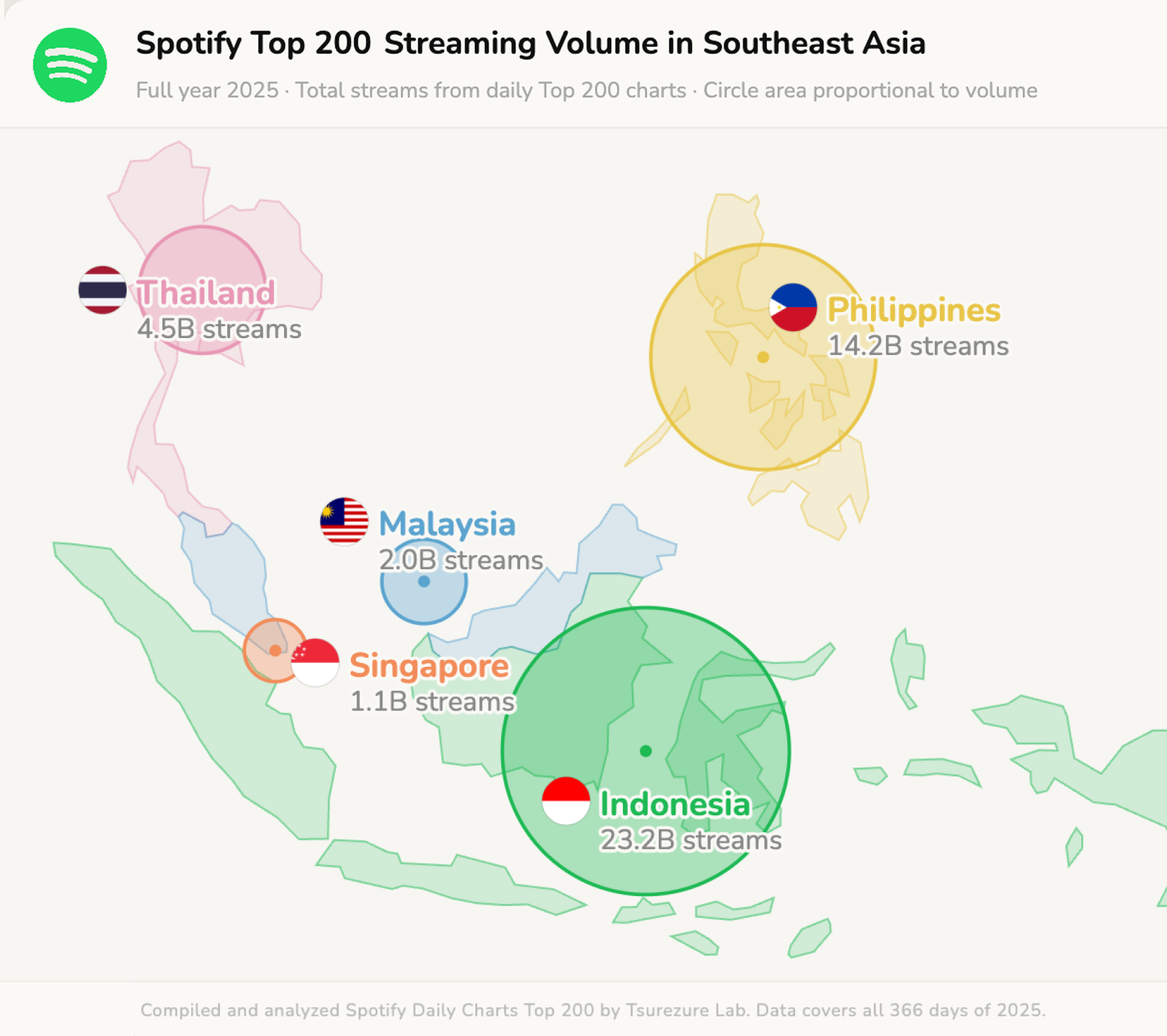
The scale becomes clear immediately. Indonesia alone generated 23.2 billion streams on the Spotify Top 200 in 2025 — more than double the Philippines' 14.2 billion, and dwarfing Thailand, Malaysia and Singapore combined.
But raw volume is only part of the story. What Tsurezure's genre-level analysis reveals is a consistent, three-year directional shift across the region: local music up, K-pop and Western pop down.
The five countries aren't following the same playbook, with the data suggesting four distinct patterns of local takeover. The Philippines is a single-genre surge, with OPM (Original Pilipino Music, the umbrella term for Filipino popular music) claiming chart share almost point-for-point from Western pop. Thailand is a genre revolution, with K-pop's collapse mirrored almost perfectly by the rise of T-Pop and Thai Hip-Hop. Malaysia and Singapore remain dependent on imported music but show early signs of internal change, with Indo Pop and Mandopop gaining ground in viral charts. And Indonesia — the region's largest market by far — has built something more complex: a three-layer ecosystem where mainstream Indo Pop, independent singer-songwriters and a new wave of hipdut each run their own pipeline from discovery to daily listening.
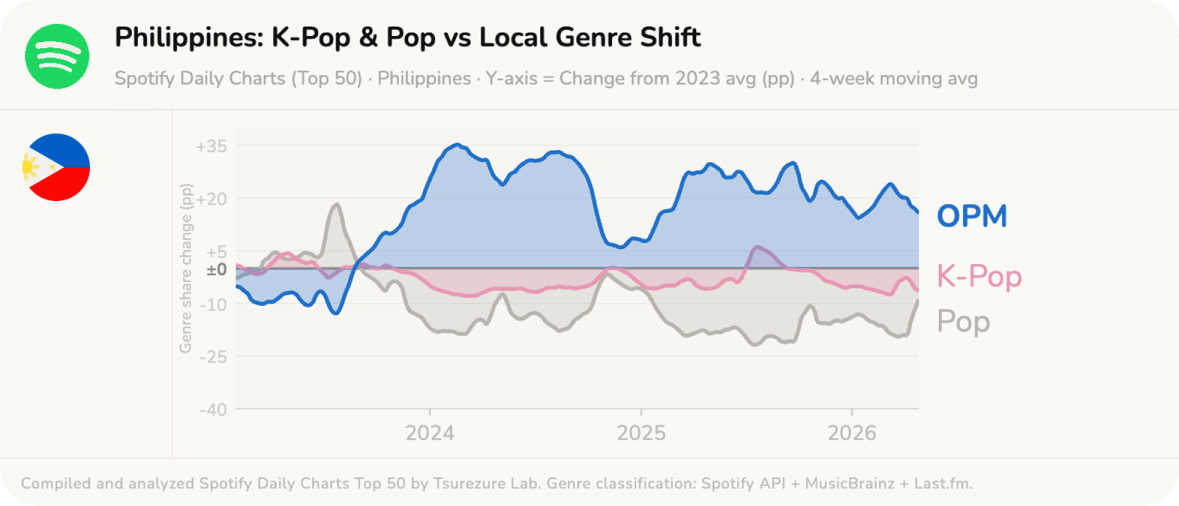
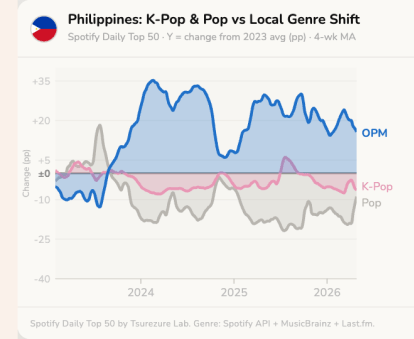
In the Philippines, the speed of the shift is striking. OPM's share of the Spotify Top 50 jumped from 44 percent in 2023 to 69 percent in a single year — a 25-percentage-point surge unmatched by any of the other countries Tsurezure studied. Since then it has settled around 63 percent, suggesting the Philippines crossed a tipping point in 2024 and entered a new equilibrium.
OPM's gain came almost entirely at Western pop's expense — the correlation between the two is r = −0.903, a near-perfect inverse: for every chart position Western pop gave up, OPM claimed it.
Part of that surge can be traced to BINI, a Filipino girl group whose rise carries a particular irony: built on the K-pop idol training model, BINI is now outperforming K-pop on its own home charts. By staying true to its P-pop roots, BINI built a global following that culminated in a Coachella performance in April, making them the first all-Filipino girl group to play the festival.
The Philippine newspaper BusinessMirror reported that the group drew some 125,000 people to its two weekend performances, the first of which has amassed more than 27 million views online, second only to Justin Bieber. Post-Coachella, BINI announced the Signals World Tour 2026, covering the United States, Canada, the United Kingdom and selected European countries.
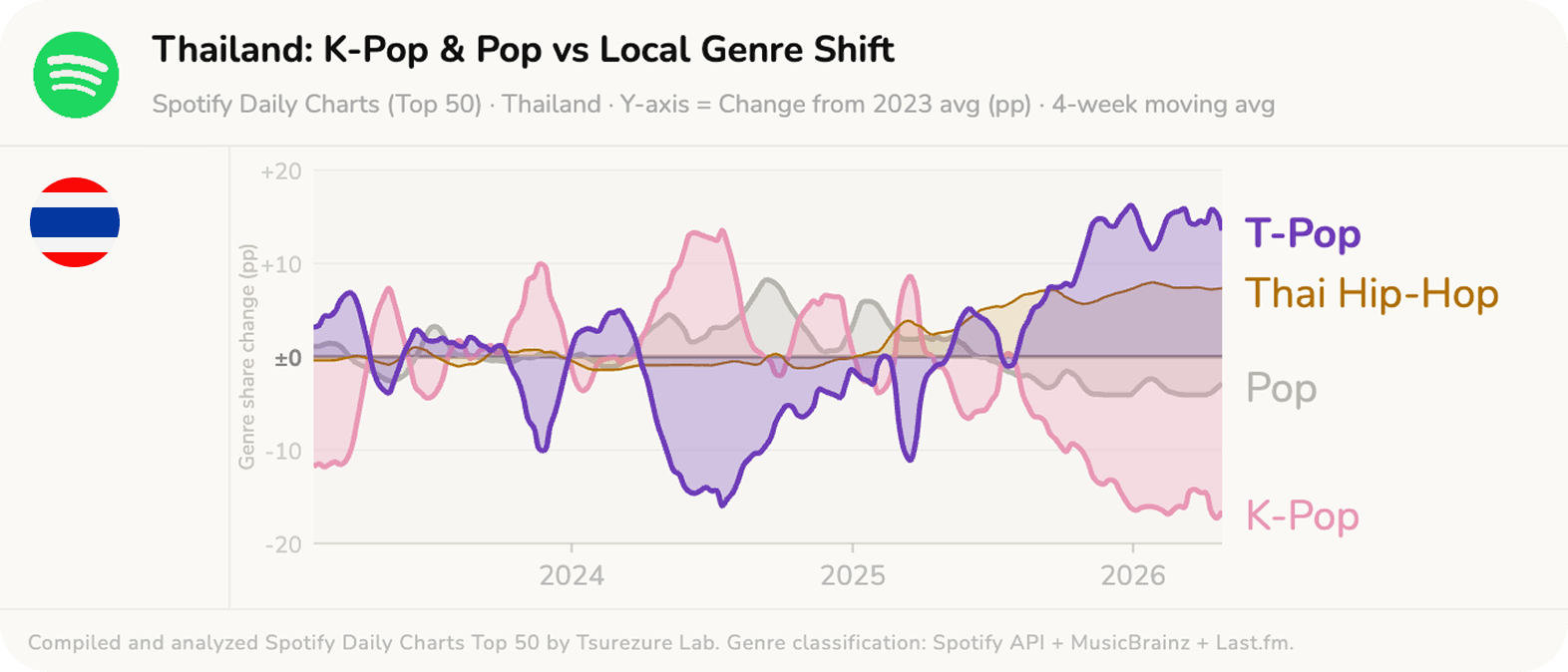
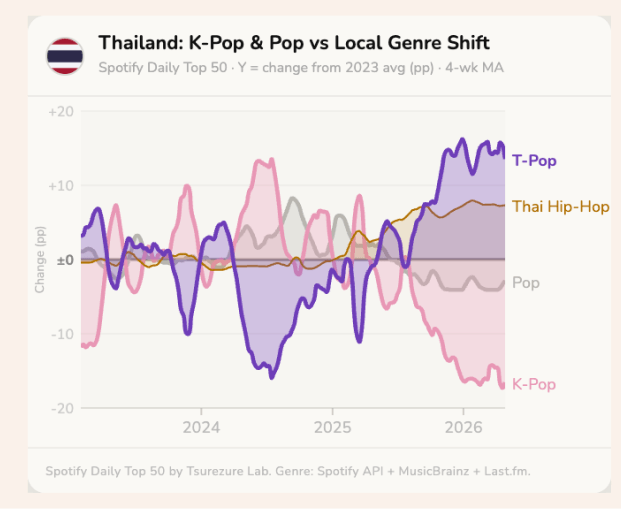
In Thailand, the shift has been the most dramatic of all five markets — and the most structurally interesting. T-pop's share climbed from roughly 65 percent to 78 percent between 2023 and 2026, while K-pop collapsed from 27 percent to 11 percent, the steepest decline among the five countries. The correlation coefficient of -0.931 is also a near-perfect inverse: chart positions didn't just shift, they were exchanged.
What makes Thailand unusual is that K-pop's exit was a two-pronged replacement. T-Pop absorbed one portion of its former audience while Thai Hip-Hop captured another — rising from virtually absent in 2023 at 1.4 percent to 8.9 percent by 2026. Milli, Youngohm, URBOYTJ and F.Hero filled the space K-pop left behind. Two local genres rose in tandem rather than competing.
Thai pop singer Jeff Satur’s sold-out Red Giant Tour across South America and Asia in 2025 confirms T-pop's growing international reach, with Forbes even featuring him as the first T-pop artist to have his music showcased at the Grammy Museum.
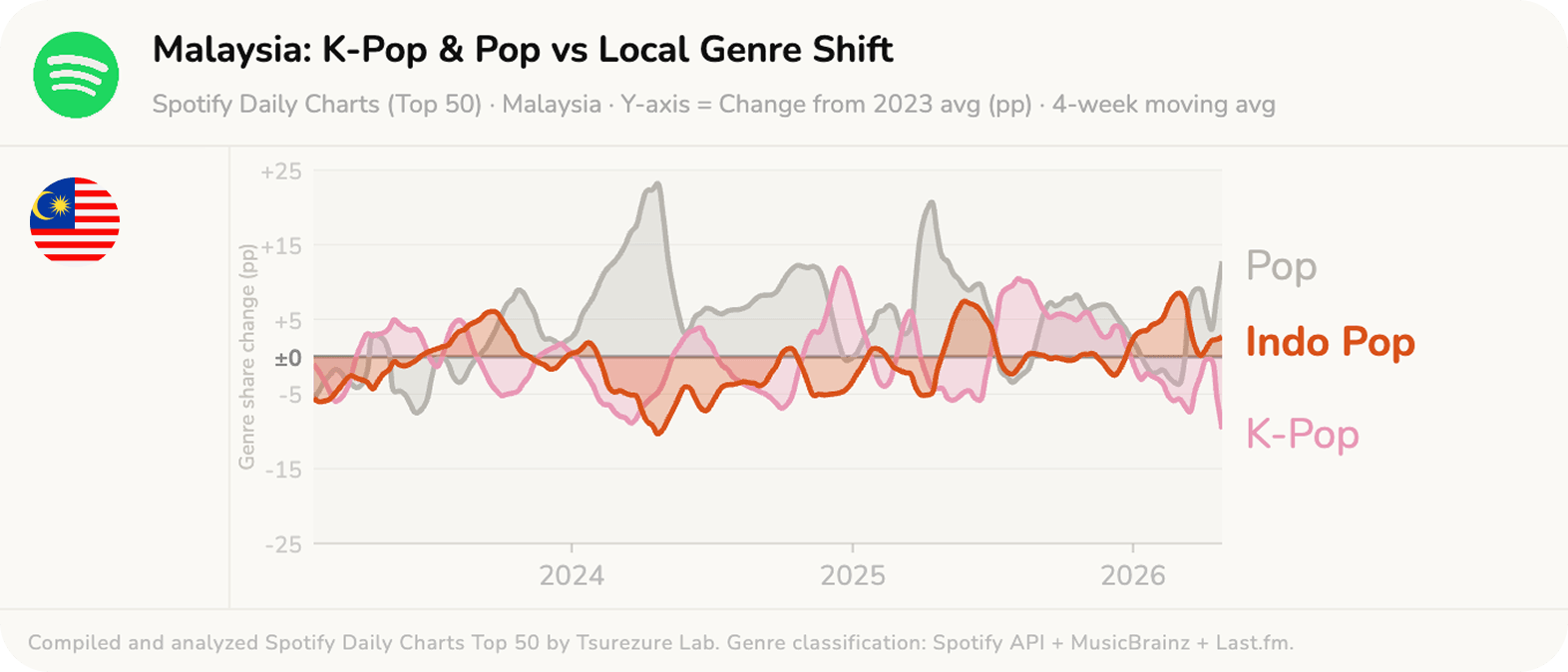
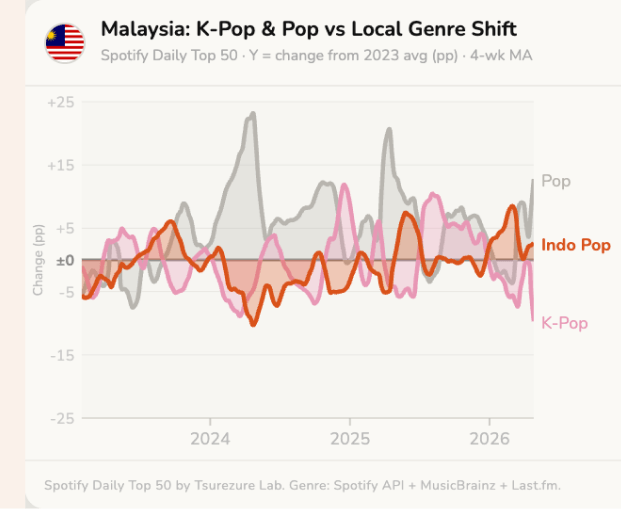
Malaysia tells the most unexpected story of the five. The "local" genre gaining ground there isn't Malay pop — it's Indonesian.
The linguistic and cultural proximity between the two countries has helped artists like Bernadya and Juicy Luicy build real audiences across the border, with Tenxi, Jemsii and Naykilla's "Garam & Madu (Sakit Dadaku)," meaning Salt & Honey (My Heart Aches), charting strongly in Kuala Lumpur.
The cross-border flow is accelerating faster than it might appear. Tsurezure has also conducted genre-level analysis that reveals a striking trajectory for dangdut-influenced music from Indonesia. It barely registered on the Malaysian Top 50 in 2023, at less than 1 percent. By 2025 it had jumped to 5.9 percent; by early 2026, 7.1 percent — a trajectory that lines up precisely with the TikTok-driven explosion of hipdut acts like Tenxi and Naykilla in early 2025.
Of the five countries in this analysis, Indonesia is the only one whose homegrown genre has established a measurable, sustained presence in another country's daily charts. In streaming terms, it is Southeast Asia's sole cultural exporter.
One other detail worth noting: classic Western pop continues to hold its ground in Malaysia in a way it doesn't elsewhere, with songs like One Direction's "Night Changes" (2014) and Charlie Puth and Selena Gomez's "We Don't Talk Anymore" (2016) still appearing in regular rotation. Nostalgia, it seems, travels well.
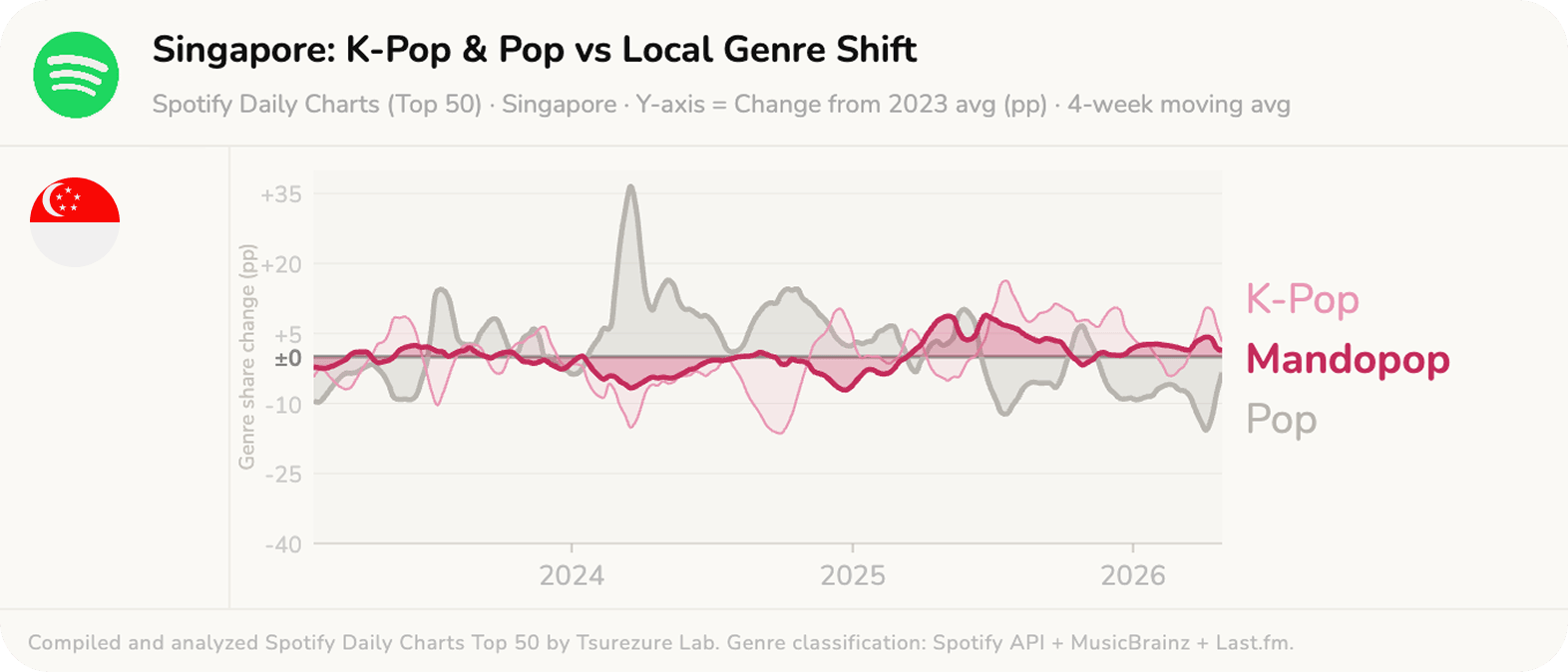
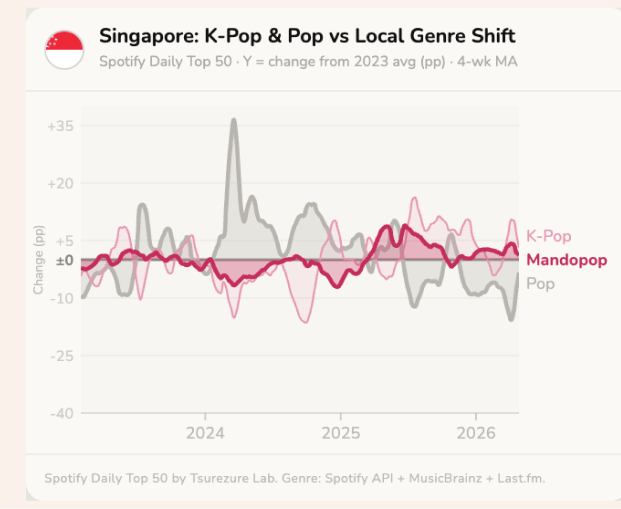
Singapore is the outlier. It's the only market in this analysis where K-pop hasn't declined — holding at around 31 to 33 percent of daily chart share since 2023, a level of entrenchment not seen elsewhere in the region. BTS members Jin, Jimin and Jung Kook and newly-launched group CORTIS continue to hold their ground alongside Western pop staples like Olivia Rodrigo.
But the more revealing signal lies in Spotify's viral charts, which track discovery rather than habitual listening. Mandopop — represented by artists like LBI利比 and Silence Wang — currently accounts for 22 percent of Singapore's viral chart, more than two and a half times its 8.4 percent daily share. That is the largest discovery-to-consumption gap of any genre across all five markets. If that viral energy converts to habitual listening, as it has elsewhere in the region, Mandopop could become a considerably larger force in Singapore within the next few years.
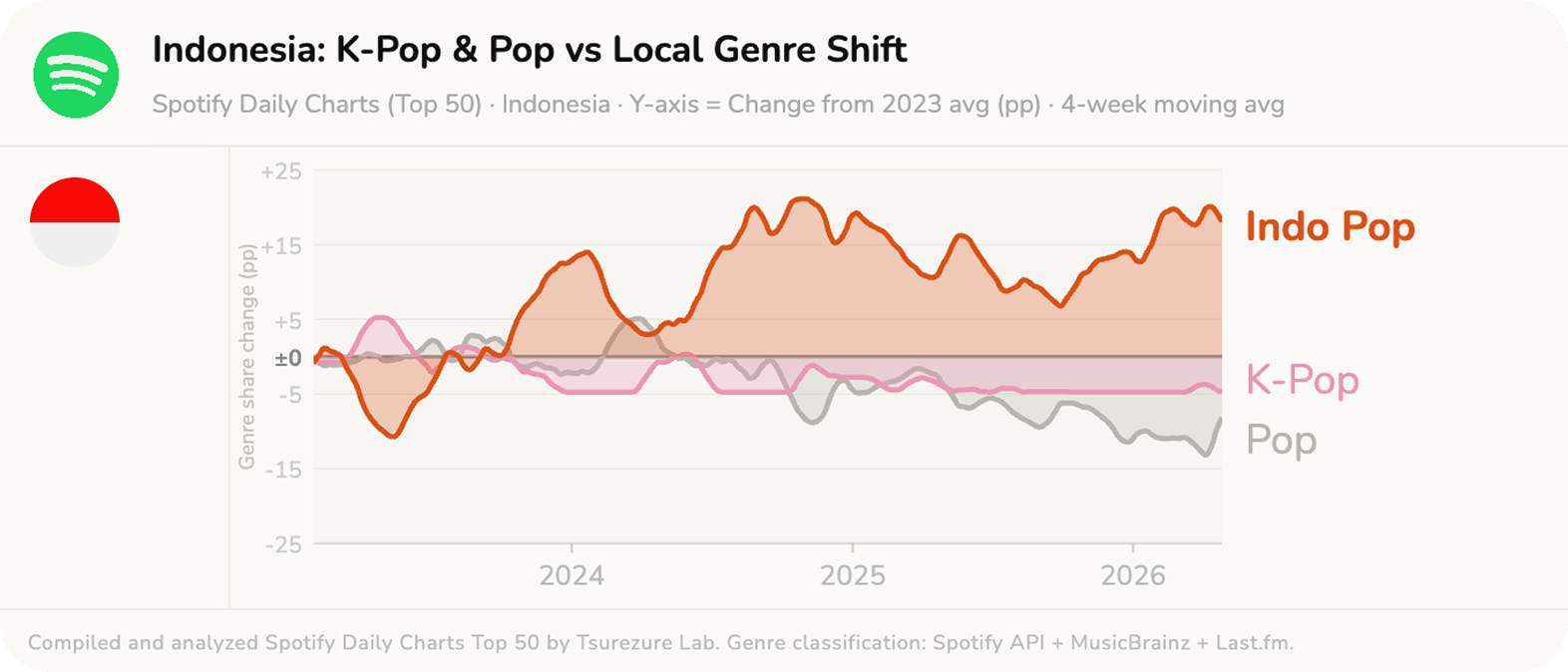
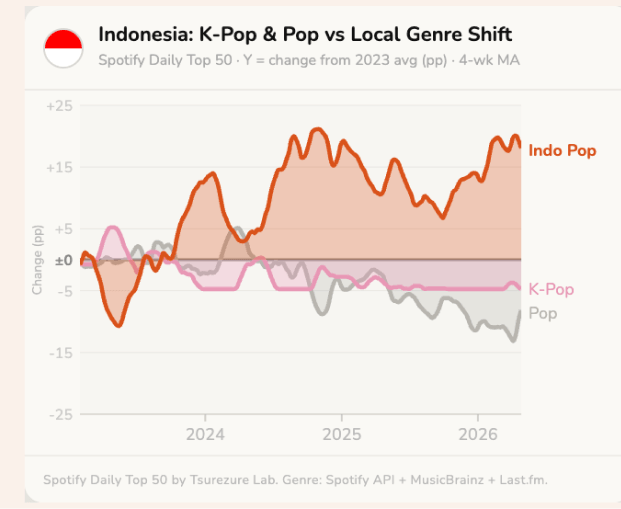
Of the five countries, Indonesia tells the most layered story — not a single surge or a genre swap, but a three-tier ecosystem running in parallel.
The first layer is mainstream Indo Pop: artists like Tulus, Raisa and Mahalini who command the majority of daily chart real estate. The second is the Indonesian indie scene, centered in Bandung and Jakarta — Bernadya, Sal Priadi, Nadhif Basalamah and Hindia, whose songs typically surface on viral charts before graduating to daily rotation. The third is hipdut, driven by Tenxi, Naykilla and Jemsii — the same artists who performed at Bengkel Hall.Each layer has its own discovery-to-consumption pipeline, and they coexist rather than compete.
The overall trajectory has been one of steady acceleration. Local genres held 62 percent of the daily Top 50 in 2023, jumped to 73 percent in 2024 — the year Bernadya and a wave of indie acts broke through simultaneously — and reached 82 percent by early 2026. Tsurezure's genre-level analysis adds a further dimension. Indo Pop's daily-to-viral gap is −41.6 percentage points, the largest of any local genre across all five markets: Indonesians aren't "discovering" Indo Pop anymore. It is simply what they listen to.
In 2025, around Indonesia's Independence Day on August 17, dangdut's share of the daily chart spiked to roughly 12.6 percent, about three times its usual level. No other country in this analysis shows anything comparable. Streaming, it turns out, mirrors the calendar of national identity.
K-pop, meanwhile, has entered what Tsurezure calls bifurcation — a pattern unique to Indonesia. Its daily chart presence has nearly vanished, falling to 1.3 percent, but it still accounts for 11.1 percent of the viral chart. New releases from acts affiliated with HYBE, the Korean conglomerate that grew from BTS’ original label, still spike in the viral rankings; they just no longer convert to sustained daily listening. The fandom's discovery circuits are intact. What's broken is the bridge to habitual consumption.
Sounds like home
In hindsight, Tsurezure's conclusion about Indonesia isn't all that surprising.
There was a time when Indonesia was a reliable market for overseas artists. In 2020, Spotify reported that Indonesia ranked second globally for K-pop streams, behind only South Korea. According to Spotify statistics compiled by Songstats in 2023, Jakarta alone had the highest number of Taylor Swift listeners, surpassing cities like London and New York.
Cut to today's charts, and that era feels like a different country.
Taylor Swift released her latest album, The Life of a Showgirl, last October. BLACKPINK dropped its latest EP, DEADLINE, this February. BTS' latest album, ARIRANG, arrived on streaming platforms in March. None of these records has dominated the Spotify Indonesia Top 50 the way Raim Laode's 2026 album, iqro' (Read), has.

There are plenty of cases in which an Indonesian artist has amassed hundreds of millions of streaming plays, but not been offered a single stage gig.
— Kukuh Rizal, Sun EaterIndonesian music audiences may not have fully registered how consistently they've been choosing local music. The generation that grew up with Spotify is a significant part of this. A growing sense of cultural pride among millennials and Gen Z has shaped listening habits, and this generation hears its own life in Indo-pop in a way that K-pop or Western pop rarely delivers.
Western pop rarely writes about romance across religions. K-pop rarely explores parent-child relationships. Neither speaks to the reality of being young, financially stretched and afraid of the future — at least not in a language, and from a place, that feels like home.
Spotify and its fellow digital streaming platforms (DSPs), which put the world's music in the pocket of any Indonesian with a smartphone, are now the same engines propelling local music to the forefront. The same algorithm that surfaced BTS to a teenager in Bekasi is introducing Nadhif Basalamah to a new listener. The shift was subtle before it became significant.
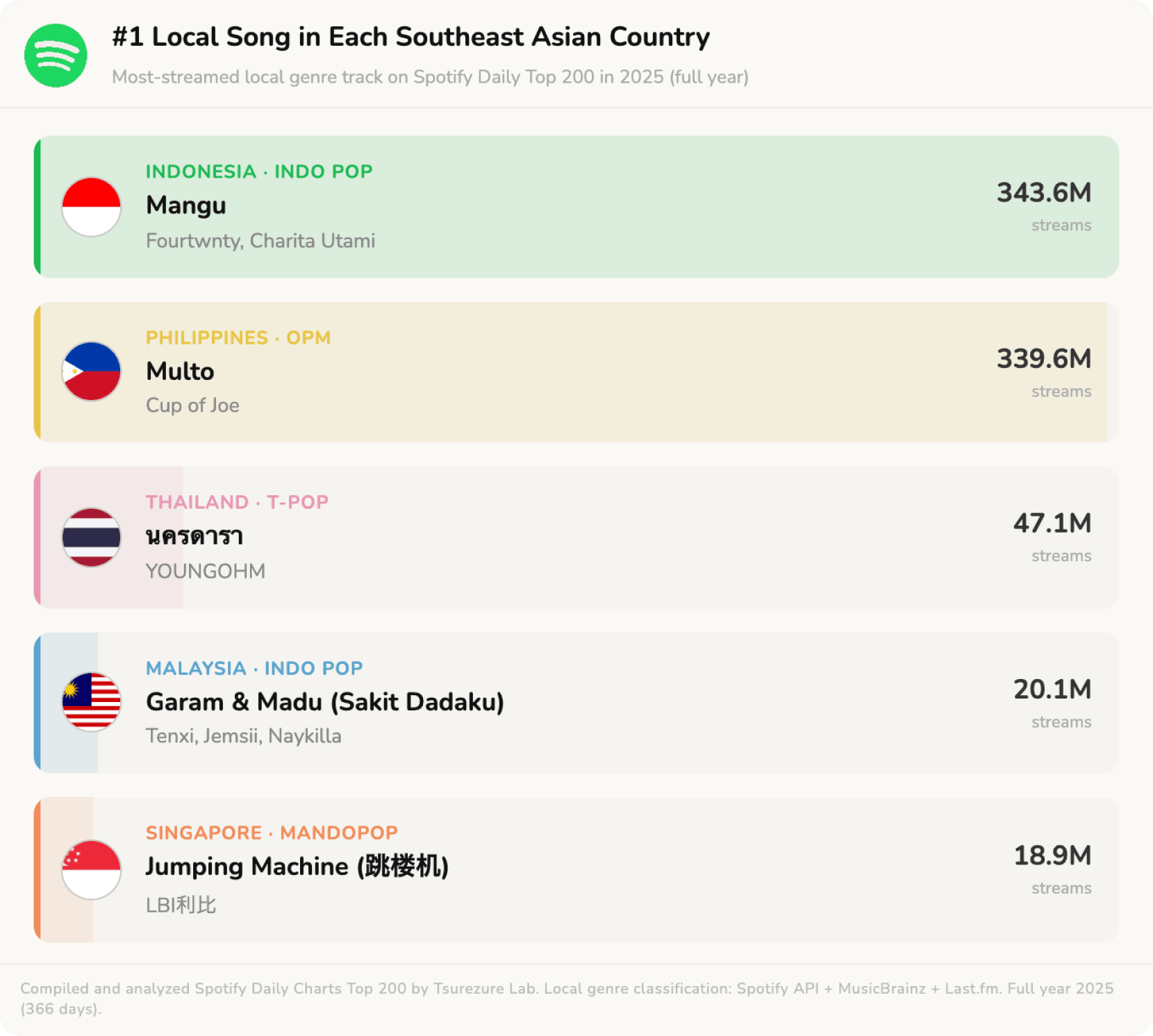
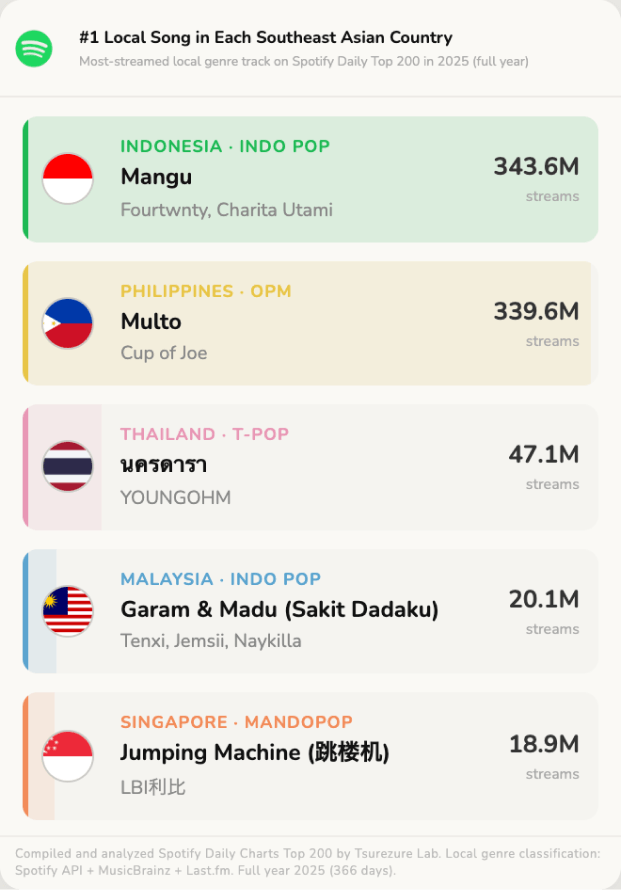
But while Indonesia has the biggest streaming market in Southeast Asia and the most structurally complex local music ecosystem, what it hasn't yet produced is the same conversion from streams to stages that its neighbors have managed.
The contrast is sharpest when you look at what the Philippines and Thailand have managed to do with their streaming success. BINI didn't just top charts — they sold out the Philippine Arena, becoming the first Filipino act to do so, before taking a world tour to London and Los Angeles. Jeff Satur sold out both nights at Bangkok's Impact Arena before expanding to Latin America and beyond.
In both cases, the domestic crowd showed up first, and the international breakthrough followed. The question worth asking is why the same conversion hasn't happened in the region's most populous country.
Double-edged sword
Indonesian songwriter and producer Ade Govinda, whose song "Masing Masing" (To Each Their Own) became a hit in Indonesia and Malaysia, isn't surprised by any of this. Thanks to DSPs like Spotify, the playing field is much fairer than it used to be.
"Back in the physical format era, we could only discover music at record stores, which were aided by national television, and the latter would certainly not want to take a risk. What national television would champion was usually pop music because, at the time, it had the biggest audience," said Ade, who has built a career in music since the 2000s.
"But in the present era, now that anyone can easily make music using their laptop at home, they get to experiment, make an account on Spotify, and subsequently find their audience. From Spotify, word of mouth soon follows, then an octopus-like growth to a huge number of listeners."
At first, this digital arena seemed to offer limitless possibilities. But democratized access to listeners came with a new set of challenges.
The sheer volume of music being uploaded to DSPs has made it harder than ever to stand out. A streaming hit can emerge overnight — and disappear just as fast.
"In the future, music is not about scale; it's about depth," said Kukuh Rizal, whose label Sun Eater is home to artists like Hindia and .Feast. "Among what's difficult is how to level up from being a 'small' artist to a 'medium' artist, as new artists keep popping up again and again."
A hundred million plays doesn't automatically translate to a fanbase that will follow an artist through the next record, the next tour, the next phase of a career.
"There are plenty of cases in which an Indonesian artist has amassed hundreds of millions of streaming plays, but not been offered a single stage gig. That's pretty common," he added.
The stream-to-stage gap
All this makes one thing clear: streaming numbers are not the same as devotion.
Indonesian audiences may stream local music obsessively, but they don't necessarily show up when their local idols perform. Some Indonesian artists can fill venues — Raisa drew 42,000 people to Gelora Bung Karno Stadium in 2023, a genuine feat. But the conversion from streams to seats isn't consistent, and the newer generation of streaming-dominant acts hasn't yet proven it can replicate that kind of turnout.
And here comes the confusing irony. BTS might not dominate the Spotify Indonesia Top 50, but many Indonesians went on a frenzy when, on May 22, it was officially announced that BTS is set to do a two-day concert at the 78,000-capacity Gelora Bung Karno Jakarta in December. Predictably, fans — hardcore or not — would call in sick for a chance at tickets.
The stakes are higher than they might appear. Streaming pays a fraction of a cent per play, and after the label, distributor and other rights holders take their share, what reaches the artist is often a fraction of that fraction. Live performance is where sustainable income actually lives.
And within live performance, there's a crucial distinction: a festival appearance means a flat fee and a shared audience — people who bought a ticket to see 30 acts, not specifically you. A sold-out solo concert means the audience came for you, paid for you, and will remember you. It's the difference between exposure and devotion. Indonesian artists are getting plenty of the former. The latter is proving harder to come by.
DATA — Indonesian concertgoers' preferences (Populix, 2024)
51%
Prefer watching local artists over international artists
57%
prefer music festivals over concert tours
61%
plan to watch a concert overseas
Source: "Beyond Borders: A Study of Indonesian Concert-Goers' Behavior," Populix, 2024


A 2024 Populix study of Indonesian concertgoers captures the contradiction neatly: 51 percent prefer watching local artists, but 61 percent planned to watch a concert overseas — budgeting more than Rp10 million (approximately US$610) for it, while preferring to pay under Rp1 million (approximately US$61) for a local ticket.
The same study found that 57 percent prefer music festivals over solo concerts, data that lines up precisely with what Ade has observed on the ground.
"In Indonesia, a music festival has become too easy," Ade said.
For Rp500,000 (around US$28), a festivalgoer can now see as many as 32 Indonesian acts on a single bill — a far cry from Coachella or Fuji Rock, where ticket prices reflect a very different set of expectations.
"A music festival is supposed to require a different kind of effort. But not the ones in Indonesia, especially Jakarta. In Jakarta alone, we can watch so many festivals. As a result, there's no way a solo concert by an Indonesian artist, whose ticket is priced at one million rupiah, would sell," Ade said.
This reality doesn't apply in Malaysia. "Solo concerts in Malaysia are almost always sold out. Why? Because the audience genuinely wants to watch the artist," he said.
The same Indonesian artists who struggle to fill rooms at home are nearly selling out solo shows across the Strait of Malacca — and that says something uncomfortable about the nature of local loyalty.
The real world
To be sure, there are Indonesian-born artists who have achieved both streaming success and international breakthroughs.
NIKI and Rich Brian are the clearest examples, though their accomplishments come with an asterisk: their catalogues are largely in English, which makes them more accessible to Western audiences, and they're signed to US-based label 88rising. Other Indonesian acts like Pamungkas, Grrrl Gang and Voice of Baceprot have also found international audiences, though their predominantly English-language catalogues have given them a similar head start.
Whether an Indonesian artist can dominate internationally with an Indo-pop sound — the way Bad Bunny has with Spanish-language reggaeton — remains to be seen. There have been encouraging signs: Idgitaf, Fourtwnty and Charita Utami have already placed Indo-pop songs on the Spotify Global Top 50.
But what about closer to home?
Back in 2014, Iwan Fals reportedly drew more than 200,000 concertgoers to Lapangan Monas in Jakarta. Kukuh isn't confident that this moment can be repeated anytime soon.
"It's difficult to reach the level of Iwan Fals," he said. "And here we're talking more than just about streaming numbers."
Streaming is easy. Real love, real admiration and real respect, in the end, come down to one thing: showing up. And we can't ask anyone to show up for Indonesian artists if we haven't done it first.
It's difficult to reach the level of Iwan Fals. And here we're talking more than just about streaming numbers.
— Kukuh Rizal, Sun Eater

Rewind
Felix Martua is a music and film journalist who has interviewed countless artists over the years. He’s known for his signature black jacket, Ghibli collar pin and slightly sinister grin.
Tsurezure Lab is an independent data analyst based in Japan who studies music streaming trends across global markets. The charts and statistical analysis in this article are based on original research using publicly available Spotify chart data from February 2023 to April 2026.
X: https://x.com/tsurezure_lab Threads: https://www.threads.com/@tsurezure_lab