(Shutterstock)
Where are you from is a common enough question travelers in Indonesia get. But as someone who lived, for much of my adulthood, simultaneously between distant homes in New York and Hong Kong, "Berasal dari mana?" invokes a complication with no easy answer. However, that question was the best practice for my earliest Bahasa Indonesia language lessons, because the multiple answers highlighted vocabulary that named various countries and their people. Argentina, Australia, India, Israel and Norway were the easiest to remember; I kept forgetting the “America Union”, the literal translation of Amerika Serikat, for the United States of America.
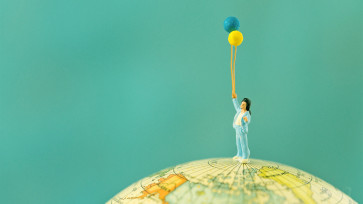
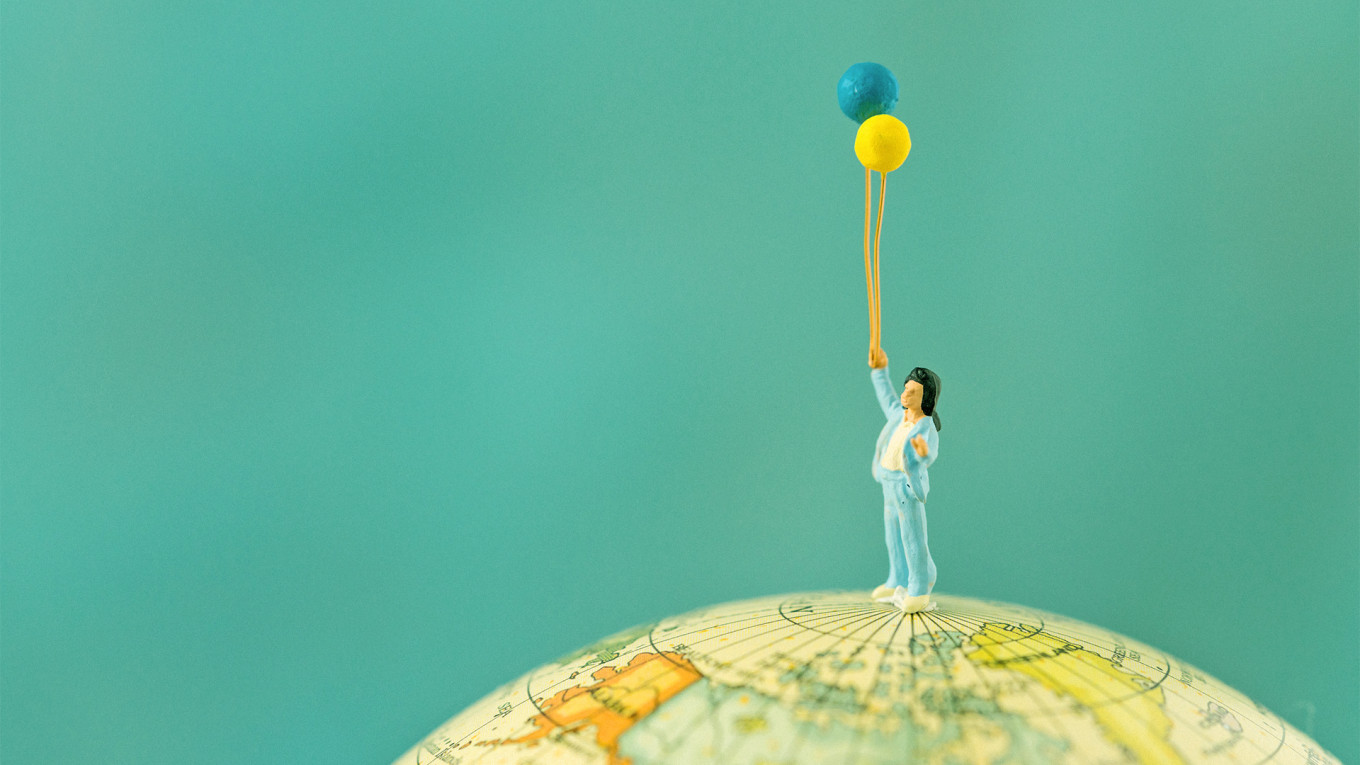
How do we first learn the origins of our world? As a child, the globe was a favorite toy because each spin could stop at yet another ocean, mountain range, continent, country, city or town. Each stop meant an adventure of discovery, usually leading to the flattened pages in the large atlas that showed, with remarkable clarity, the exact positioning of each place. Even as a child, I dreamed of becoming a warga negara dunia, a world citizen, who could then answer the question "Berasal dari mana?", with "Dunia, dunia, dunia!"
Long before Google Maps attempted to take over the globe, skewering what it means to know “our world,” it was commonplace to find globes and atlases in libraries and schools. Although you couldn’t “see” the world on screen with a single click, you understood that you originated from and existed in a real but very complicated planet, one that would take time and study to understand. After all, this tech skewering is rather like satay, where you only get pieces of whatever animal flesh you cook, and you’d need to eat many, far too many sticks of satay to digest the whole. I was disappointed to first discover that Earth was not perfectly round; after that, a globe became representational, a kind of fiction, a story of where we all belonged.
But stories shouldn’t be too easy, should they? As a storyteller, I find virtual access to “seeing” the world rather simplistic. Just as you don’t really “know” someone you’ve seen, friended or followed on social media, you haven’t really “been” or truly discovered a place if it’s all only virtual, no matter how spectacularly amazing the videos or photos might be. It’s not unlike stories that merely titillate or offer easy and predictable outcomes. Why bother reading, or worse, writing anything that doesn’t dare to disturb the universe for yourself and your readers? T.S. Eliot dared, and love him or hate him we continue to read him. After all, isn’t the joy of being alive simply because there’s still so much to learn and discover?
"Berasal dari (or di) mana?" is more than simply where are you from, although of course, that is its simplest translation. Berasal, an intransitive verb composed from the noun asal, meaning origin, speaks to something other than merely place. Origin embraces family, country, culture, history, perhaps even gender, language or religion. It can even depend on who you are at the moment of the question. A traveler’s response to "Dari mana?" might be the last country they were in or the country they’re from, although someone who’s just lost their home due to a flood or bombing might say nowhere. The real answer, I believe, is "Di sini di sana," because isn’t that the truth of our origins, that we’re really from here and there, this or that, mother or father or no family at all? Or where- and what- ever happens to be our particular reality right now?

Thank you!
For signing up to our newsletter.
Please check your email for your newsletter subscription.
One way to write about a place — by training the mind’s eye across as much as it can absorb, be it globe, map, photos, virtual reality and a range of writing or literature about that place and maybe even Google Maps — does help you get to the origin of creative inspiration. What inspires you is a common question writers often get. My answer often is what I don’t know or understand.
Why does place matter for a writer? One of the lessons I teach in creative writing is that a place belongs in a story, even if that place is entirely interior, in someone’s mind for instance. Place anchors the world of any narrative, whether it’s a real or imaginary one, and addresses its raison d’etre. In speculative or science fiction, we often speak of “world building” as an important element of crafting such work.
For example, I first began writing this essay in an airport. No place makes me think about dari mana as much as a space of transition, when you’re neither di sini atau di sana (here nor there), but suspended in a temporary mana (where). The George Clooney movie “Up in the Air” speaks to that curious suspension of travel where all fictions are possible. If we’re not careful, we can fool ourselves into believing our own fictions, which is probably why more “adventures” happen to travelers than to those who stay at home. But adventures, as I’ve discovered from spinning and traversing the globe, especially as a writer, are actually all in your head. The real discovery is when you figure out from what and where you really originate and then maybe, just maybe you’ll have something to say.
It’s an ongoing quest to know what to say and why, and a good reason to love being alive. Dari Mana? Dari hidup? (From life?) Over a waktu lama (a long time), perhaps?
Xu Xi (Sussy Komala) is an Indonesian-Chinese-American writer from Hong Kong. A diehard transnational, she long inhabited the flight path connecting New York, Hong Kong, and the South Island of New Zealand.