(Shutterstock)
Am I Indonesian? Until 1987, I was an Indonesian national. Yet I had never lived in the country and could speak little more than baby Indonesian. Tidak bisa, I would reply, shamefacedly, whenever someone addressed me in the language. Still, I always described myself as Indonesian-Chinese.
Later, after I naturalized as an American in October 1987 and had to give up my Indonesian citizenship, I became Indonesian-Chinese-American. This hyphenated identity seemed to accommodate my nationalities, ethnicities and cultures; but it did not quite answer the question of how Indonesian I actually was.
I was born and raised in British colonial Hong Kong by Javanese parents. Mum arrived in the city from Cilacap, via the Philippines by boat, after the Japanese occupation ended in 1947. Dad came two years later, flying in from Shanghai after the Communist takeover during the Chinese Civil War. He had been a student at St. John’s University and was originally from Tegal. Though both hailed from Central Java, my parents met, fell in love, married and raised my three siblings and me as Indonesian nationals in Hong Kong.
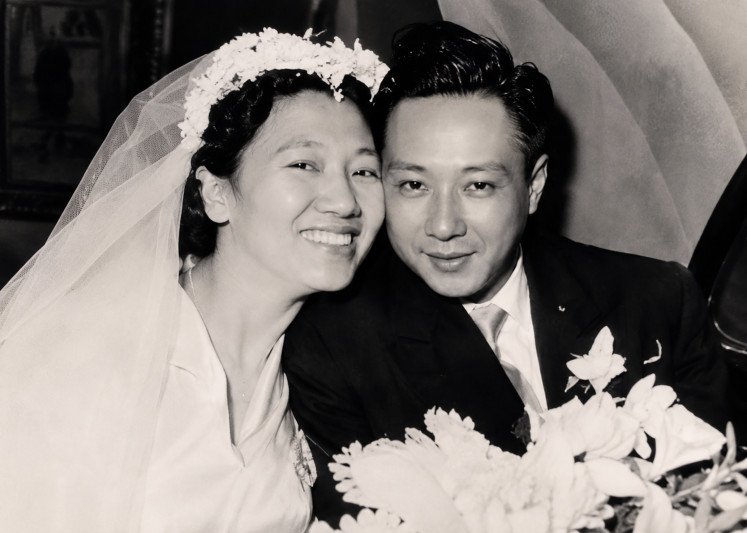 (Courtesy of Komala family archive)
At home, we were an English-speaking family unit, and reasonably fluent in Cantonese because that was the language around us. When my parents wanted to talk behind our backs, they spoke in Javanese. Dad also kept up with Indonesia through Kompas, which somehow found its way to our house in Hong Kong every day. So he knew Bahasa Indonesia, and the language surrounded us without it ever becoming our own.
In 2018, I finally decided it was time to learn it.

Thank you!
For signing up to our newsletter.
Please check your email for your newsletter subscription.
Orang mana? Orang apa? were among my early lessons. Where are you from? What are you?
How should I answer?
Was I really Indonesian when I had so little familiarity with either the language or life in the country except as a visitor? I knew plenty of overseas Chinese whose relationship to China resembled mine to Indonesia: ancestral and cultural, but geographically distant. However, I rarely met fellow Indonesians like myself. Other Indonesians abroad, including those of my generation who had also been born in Hong Kong, at least spoke Indonesian. And yet, there were other ways in which Indonesia felt unmistakably familiar to me.
I loved everything pedas, and Mum’s cooking was much more Indonesian than Chinese. Moreover, I knew enough about the culture to recognize it as mine. But did any of that really count?
The first time I went to Indonesia was in 1977, on a business trip to Jakarta for Cathay Pacific Airways from its Hong Kong head office. Almost immediately, Jakarta felt strangely familiar. The culture, the food, the way people behaved around one another, so much of it resembled the world I knew at home.
People told me that my English-language skills would easily land me a job, and I very much wanted to move to and work in Jakarta, then finally learn Indonesian. At the time, I had recently returned to Hong Kong after earning my B.A. at a university in the United States and knew that I preferred life in Asia. Back then, holding an ASEAN passport was also a privilege in Southeast Asia in ways it was not in the West.
For a while, Indonesia seemed like a place I might choose for myself. Yet my parents actively discouraged me.
Their memories of the country they had left were very different from what I saw. Indonesia was too slow, too backward compared with Hong Kong or the West, they said, where there were better opportunities for education and work. And Indonesians did not always treat Orang Cina well, they continued to reason with me.
What I saw, however, was a country modernizing. Orang Cina seemed very Indonesian and increasingly integrated into the mainstream, unlike in the Indonesia my parents and grandparents had known. To my parents, Indonesia was a place they had left in search of a better life. To me, it briefly seemed like a place I might enter and finally belong.
In the end, I did not move there. I returned to the United States for an M.F.A. in fiction, became American and spent much of my adult life moving between New York and Hong Kong. Since 2018, after Mum died, I have lived only in New York.
It has been a good life. I have an identity as a Hong Kong writer because much of my writing has been about the city where I was born. I will likely die in New York. My parents never returned to Indonesia to live either. Both died in Hong Kong, which had become home for them.
And yet their Hong Kong home remained staunchly Peranakan Indonesian.
Neither of my parents ever became fluent in Cantonese. English was always a second language. What filled our house instead were memories of soto ayam, sate, gado-gado, rendang, nasi goreng, kerupuk, petai, sambal, salak, rambutan and durian, and the Indonesian chatter of relatives and friends, fragmented by English, Cantonese, Mandarin, Fukienese and even a little Dutch.
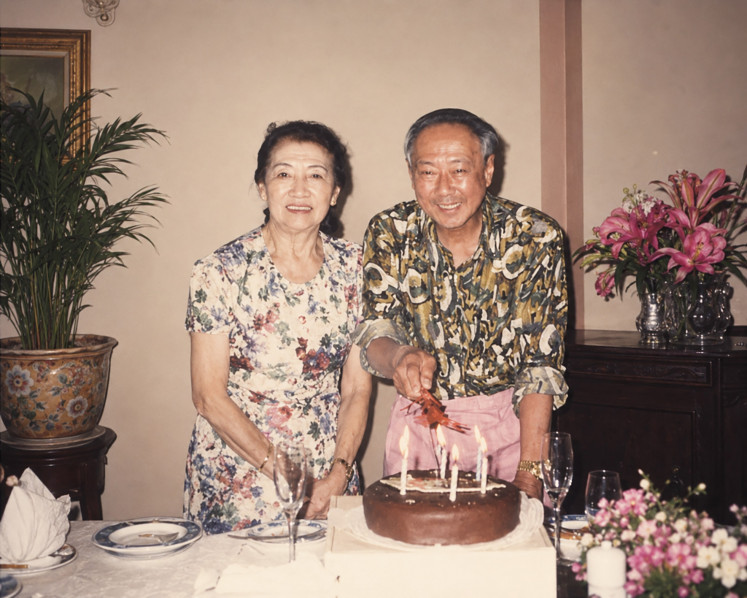 (Courtesy of Komala family archive)
Mum’s family had lived in Indonesia for five generations and Dad’s for seven, both intermarrying with local Javanese families. To me, my parents were therefore more Indonesian than Chinese.
Perhaps that was partly why not speaking Indonesian always felt like an absence. What, after all, forms an individual’s identity?
Language is certainly one factor, but where, and perhaps more importantly, how, you have lived gives you a sense of self that is more complicated than nationality or ethnicity.
 (Courtesy of Komala family archive)
As I learned Indonesian, I began to understand something else: the structure of the language gave me a different appreciation of my parents’ mental world. They rarely used the pronoun “I”, so fundamental to English and especially to American English. Their decision-making tended to be communal rather than individual, as though whatever the group or surrounding community wanted should take precedence over personal desire, although they would complain afterward if the decision was not to their liking. Even Dad, who had a habit of issuing edicts, some of them unreasonable, could eventually mellow through discussion.
Nothing was ever entirely definitive.
That felt very different from the English in which I had built most of my adult life, especially American English with its preference for directness and the sovereign “I”.
Some of my favorite Indonesian vocabulary reflects that difference: jam karet, mungkin, kadang-kadang.
Then there were concepts that delighted me: rumah panas, because ghosts are “hot”; kamar kecil, because W.C. privacy is “small”; or pekerjaan yang membosankan, which perfectly captures the boring experience of the treadmill, especially for a gym rat like me.
But most surprising of all was the grammar.
Indonesian grammar proved delicious, particularly the verbs and their multiple constructions: meng-, men-, mem-, menye-, menge-. It was unexpected, strangely layered and rich. Somehow, my own experience of learning the language belied what foreigners said, that Indonesian was such an “easy” language to grasp. Perhaps it’s true if you’re just learning how to converse in Indonesian, yet the real language performs somersaults in many ways, especially through its verbs. Indonesian made me see new possibilities in grammar and, consequently, in meaning.
Discovering Bahasa Indonesia became a kind of self-discovery.
I went to Jogjakarta twice for intensive in-person classes and, the rest of the time, studied individually by Skype, often at four or five in the morning (New York time) to accommodate my tutor’s schedule. I worked my way through intermediate-level textbooks virtually when COVID-19 made travel to Indonesia, or anywhere else, difficult.
Eventually, I could no longer keep up with the virtual classes. My last job in Massachusetts required relocation and subsequently a long weekly commute from New York. It has now been more than three years since my last lesson.
Still, mastering Bahasa Indonesia remains an unfinished business, a personal goal I will continue to pursue.
I want to hold on to the culture my parents bequeathed to me, and language offers one way to do that. Perhaps it can also make me a little less of a liar whenever I say: saya orang Indonesia.
Xu Xi (Sussy Komala) is an Indonesian-Chinese-American writer from Hong Kong. A diehard transnational, she long inhabited the flight path connecting New York, Hong Kong, and the South Island of New Zealand.