(B/NDL Studios/Budhi Button)
What is the first thing that people notice about you?
Maybe it's your hair length, your outfit, the shape of your jaw, or your voice. And, always, these features coalesce into what they think your gender is.
Every action others take thenceforth, from how they talk to you to the distance they keep from you, is based on whether you are considered a man or woman.
Personally, I didn't want to be noticed – I wanted to be known. I wanted to be more than the sum of my parts, categorized into a word.
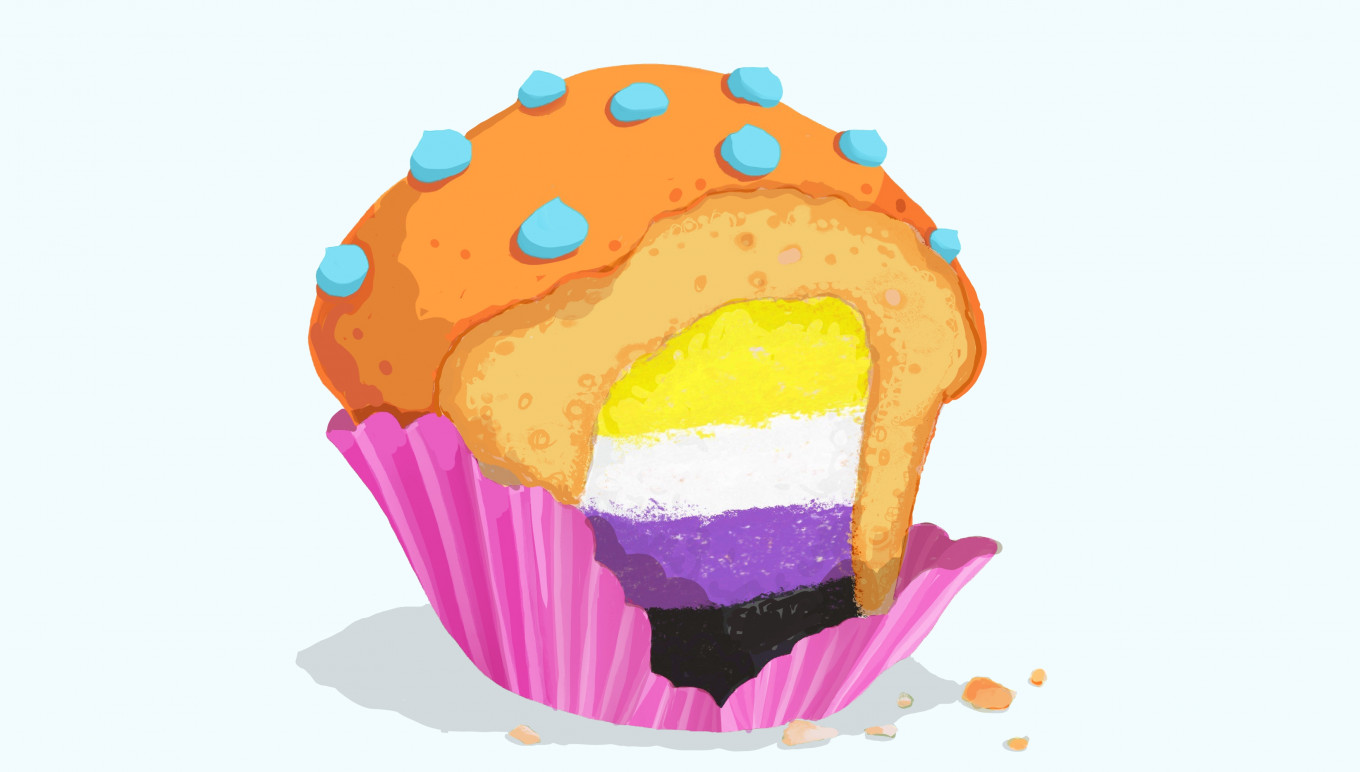
So, I became neither.
Thank you!
For signing up to our newsletter.
Please check your email for your newsletter subscription.
Iwas a teenager when I first became acquainted with the term “nonbinary”, thanks to the internet. At the time, for myself and perhaps for most people, the term “nonbinary” was pointing toward an elusive third gender: those whose appearance and behavior are often a blend between traditionally masculine and feminine characteristics. I had always been an androgynous kid and was mistaken for a boy more times than I could count. I hated that, because any questioning of my girlhood felt like an accusation, as though being different had somehow turned me into a freak.
Growing up a tomboy, I knew little about the things that came naturally to other girls, makeup, nail polish, or something as simple as tying my hair felt foreign to me. And everywhere I went other girls would throw stares and comments at me, reminding me that however hard I tried I would never fit in. This stuck with me for years.
Everything about me was different from other girls and I couldn’t stand it. I didn’t want to be androgynous or masculine, I just wanted to be a normal girl.
But being normal came with a price, which I didn’t mind paying at the time. When I started to show an interest in more traditionally feminine things, I could sense some form of validation from the people around me, friends and family. For the first time in my life, I felt accepted, and I was no longer a stranger looking into a world of normalcy, I was part of that world. It didn’t matter that every time I looked into the mirror, I couldn’t recognize the person standing before me; or that every time someone called me a girl, it made me feel uneasy. The trade-off was clear, and I would do whatever it took to feel normal.
Still, masculinity always found its way back, rearing its ugly head and provoking me with a deep yearning I could not ignore. By the time I was in college, I stopped resisting the desire to embrace myself. I cut my hair short (the same hair I had once insisted would always stay past my shoulders) and abandoned the feminine wardrobe I had carefully assembled as part of a self-imposed project to turn myself into a “normal” person.
Yet there were also parts of womanhood I enjoyed: the makeup, the expression, and primarily, the community, these I decided to keep. I wanted to be connected to other women, to the spirit of feminism, because the persecuted second sex only has each other to rely on for survival. I didn’t want to cut myself off from my sisters, my people, even if my appearance and style did not conform to theirs.
Embracing my masculine side didn’t mean I wanted to be a man. I was comfortable with my female body and voice, as well as other traditional markers of the female gender. I didn’t feel the need to flatten my chest or lower my pitch. As a result, I became the in-between genders. My differences were subtle, not enough to conform to either male or female characteristics.
Having been exposed to the term nonbinary didn’t immediately make me want to use it as a label for my own existence. It felt like a commitment I couldn’t uphold, so I continued to identify myself as a woman. After all, if I could stomach calling myself as a woman, how could I be nonbinary?
Later, after meeting more people who identify as nonbinary and listening to their stories, I began to realize how my understanding of gender had been far too narrow. I met somebody who identified as bigender but presented themselves as a traditional woman, and another who underwent hormone replacement therapy yet identified as nonbinary rather than as the opposite sex.
It occurred to me that what I had initially understood about being nonbinary was completely wrong. It isn’t a third gender. If men are 1 and women are 2, nonbinary people aren’t 3. They are the infinite decimals between those numbers, the whole numbers that come before and after them, the negatives and imaginary numbers, the variables yet to be solved.
Nonbinary cannot be simplified as a blend of man and woman. It is everything that exists beyond that binary.
When I began to explore my gender identity, I gravitated toward the label agender, which basically means someone who does not identify with any gender. Over time, though, I settled with the label nonbinary, because I didn’t want to be tied to any single definition. Moreover, in my mind, the label agender felt too specific for an experience that continued to evolve.
What I wanted was to be free of the shackles of gender, to exist without boundary. Isn’t that how every nonbinary person feels? Well, as it turned out, not really.
While my desire is to be like air, floating in a shapeless existence, Bintang wants to try on every shape there is to offer.
“I want to experience and live in every gender possible in this world,” Bintang said. “While I completely reject gender boxes and distinctions, we still live in a cis-hetero-normative society. So, as my act of rebellion, I want to identify myself as every gender possible in this world regardless of my genitalia.”
Identifying as genderfluid, Bintang doesn’t really care whether others label them as man or woman. The same sentiment is shared by others who identify as nonbinary, though some are less bothered when others perceive them as a gender different from the one they were assigned at birth.
“The label ‘woman’ just never sits right with me because my experience is more relatable to that of a man than a woman, despite being AFAB [assigned female at birth]. Being perceived as a man, however, gives me less conflicting feelings,” Zoe, a masculine nonbinary, shared.
For many nonbinary people, myself included, being perceived as the opposite sex can feel more tolerable, even desirable, than being perceived as the sex they were assigned at birth. After spending a huge chunk of my teenage years trying to fit into conventional expectations of being a woman, being mistaken as a man now brings an unexpected sense of relief. It reminds me that the person others see is no longer confined to assumptions that never fully fit my true identity.
“I love it when sometimes people think that I’m a girl while my clothes at the time do not really scream ‘feminine.’ I think it’s a very affirmative experience,” said Bintang.
There is a common assumption that nonbinary people must be uncomfortable with the sex they were assigned at birth. This may be true for some, but the idea is often pushed a step further, particularly in discussions about people assigned female at birth (AFAB), where gender transition is framed as a rejection of, or even hatred toward, one’s birth sex.
For years, I wrestled with the same question: Was I really nonbinary, or did I simply hate being a woman?
Nero, 30, shared my ruminations.
“Calling myself nonbinary is the easiest thing for me. I hated being a woman but [I did not want to be] ‘manly enough’ to be a man,” Nero explained. “What’s hard is the process that comes after it. It is surprisingly a lot of mental work to deconstruct what is considered masculine and feminine, and my personal bias regarding both genders.”
My own process was more or less similar to Nero’s. I found myself untangling what was authentically mine from what stemmed from internalized misogyny or lingering queerphobia. I questioned whether my discomfort with dresses came from seeing femininity as lesser, or simply from feeling more at home in masculinity.
Today, my hair is shorter than ever, and I spend plenty of time at the gym trying to broaden my shoulders. I embrace masculinity more openly than I did before, but I have also grown more comfortable with femininity, wearing makeup and painting my nails without hesitation. Femininity no longer feels like an obligation or a performance; and it is no longer something I do to fulfill a gendered expectation, and instead it is a choice I make for myself.
Nero experienced the same shift in perspective: “[Identifying as nonbinary] has surprisingly made me more accepting of being AFAB. As I worked through dismantling the internalized misogyny and misandry, I came to appreciate feminine qualities more.”
If you’re on social media, you’ve probably come across some variation of the meme: “I’m probably nonbinary, but I have a job, so I don’t really care about that right now.”
People often share it about themselves, usually prompting a chorus of agreement in the comments. As someone who has felt secure in my nonbinary identity for years, I find it quite funny.
But it also gives me pause.
For a lot of people, there is a quiet sense of disconnect from their assigned gender, or from the concept of gender in general. Yet it is often easy enough to set those feelings aside and focus on the demands of everyday life. Truth be told, I used to do the same. For a while, I could ignore the discomfort; though eventually it always found its way back.
Like an inconvenience, the feeling can be fleeting and is easily forgettable without fully disappearing. For some nonbinary people, gender dysphoria is arguably less intense compared to the experiences commonly associated with trans men and women, and the classic narrative of being “born in the wrong body” may not resonate with them all.
The experiences of the people I spoke to, for example, is a clear reflection of this diversity. While Bintang and I have generally felt comfortable in our bodies, Zoe and Nero described a deeper sense of disconnection. In Zoe’s case, that disconnection persists to this day. Some people pursue medical interventions to ease the discomfort; though there are others who don’t feel the need to make drastic changes in their lives after identifying as nonbinary.
Such variation is partly why questions of gender can be so easy to postpone, until the discomfort becomes unmanageable. Coming to terms with being nonbinary can be a lengthy and lonely process, made more difficult and complex by the realization that there is not a single nonbinary experience to relate to.
In many ways, nonbinary identity resists traditional definitions and categories. For some critics, that resistance is precisely what makes it difficult to accept. How, they may ask, can an identity be real if it does not fit into an existing framework?
Even within queer communities, the same questions are often put on the table with great scrutiny. For decades, many LGBTQ+ people have relied on the idea that we were “born this way” as a defense mechanism against attempts to change or invalidate the community. The argument is simple: our identities are innate, not chosen, and therefore cannot be willed away.
For the first time in years, that line of thinking shook me. Was I born nonbinary?
Many of the nonbinary people I spoke to described social expectations and gender norms as important factors in how they came to understand themselves. Others did not experience the intense desire to transition that is often associated with trans narrative. If that was the case, then what exactly made someone nonbinary? And if my identity was shaped, at least in part, by reflection and choice, did that make it any less real?
For me, becoming nonbinary felt less like uncovering a hidden truth and more like making a conscious decision about how I wanted to be aligned with my own truth. So, if this was a choice, was it still real?
In my view, nonbinary is no less real than man or woman. If society accepts gender norms that shift across cultures and generations, then it shouldn’t be impossible to accept the fact that people’s relationships with gender can evolve as well.
Bintang put it best. In their words, “One hard-to-swallow pill this society needs to acknowledge is that what and who defines a man and a woman is always changing over time. And it will keep changing whether you like it or not!”
After years of questioning my gender, living as nonbinary, and having that identity challenged more than once, I still can’t tell you with certainty whether nonbinary exists as an objective truth. Perhaps I never will.
What I can tell you is this: there are a few things more real than the ease I feel when I look in the mirror and recognize the person staring back at me. Finally, I have become the only person I ever wanted to be.
Nia hasn't always been a writer, but they've always been fond of yapping. Now they write so when people can't hear them, they can still be seen.