(Shutterstock)
The audience numbered in the hundreds: mechanics and small retailers, office workers and academics, mingled as they squatted or stretched out on the dry lawn in front of the stage. Headscarved women cradled children on their laps, whorls of spicy smoke floating above them, as their husbands chain-smoked clove cigarettes.
It was 10 at night on a Thursday in South Tangerang, a suburb of Jakarta, and it wasn’t a popular band or comedian that the crowds had gathered to watch, but rather, an extraordinary classical art form called wayang kulit. This is an Indonesian shadow puppet performance wherein ancient stories from the Ramayana and Mahabharata are brought to silhouetted life on a screen, using backlit figures cut from raw buffalo hide.
On this evening, a well-regarded dalang, or puppeteer, from East Java was performing the story of the birth of Rahwana (Ravana). The enactment had a hypnotic quality to it with an energy that ebbed and flowed. Long lulls in the action when the dalang narrated the story were suddenly interspersed by the singing of a female chorus, accompanied by a gamelan orchestra. The clashing and clanging of bronze gongs and xylophones, fused with the high-pitched singing to evoke a dream-like mood, conjured off-kilter possibilities.
The performance lasted another three hours, being an abridged form of the full-length version that typically lasts the whole night – often starting at around nine pm and continuing until four or five the next morning.
Wayang kulit has a history that stretches back over a thousand years. A copper plate from the central part of Java that dates back to 907 CE has been found with an inscription describing a wayang performance featuring the story of Bimaya Kumara (Bhima’s adolescence).
The reference to Bhima is significant. In Javanese culture and mythology, Bhima is known as Bima or Werkudara, the divine descendant of the god of wind, Batara Bayu. However, his origin story can also be traced back all the way to the Mahabharata, the Sanskrit epic that traveled to the archipelago alongside other Hindu influences from India.

Thank you!
For signing up to our newsletter.
Please check your email for your newsletter subscription.
Hinduism made inroads into the islands of Java and Sumatra from early in the Christian era, as traders and priests from India traveled to the region. By the seventh century CE, Hindu kingdoms were dominant on both islands. Ever since, Hindu-Buddhist cultural norms have infused indigenous mores in these parts of Indonesia, even after the local population largely converted to Islam in the 16th century, making for a startling syncretism that survives till today.
Wayang is the most tangible manifestation of Indonesia’s pluralism. Although 87 percent of the country’s citizenry is Muslim, the imagery and idiom of Hindu epics is inextricably intertwined with the quotidian here. My local mechanic, when I lived in Jakarta, was called Rama Repairs, and my Muslim real estate agent was named Dewi. I discovered a nation-wide charitable foundation for twins called the Nakula and Sadewa society, and a support group for Indonesian women in mixed marriages named Srikandi (Shikhandi).
In fact, wayang is thought to have been used by the so-called Wali Songo, or the Nine Saints, the 15th-century Islamic scholars credited with spreading Islam in Java. The use of wayang as an art form to introduce Islamic teachings made the religion more accessible to local communities.
Moreover, the art form is also believed to have been used by Christian missionaries, who adapted wayang performances as a means of communicating biblical stories and Christian teachings to local audiences.
Wayang and politics have long been enmeshed. From the Islamic sultans of Java to modern-day nationalists like Sukarno and military dictators such as Suharto, wayang has been employed both to legitimize power and, at times, to challenge it.
In Indonesia, stories centered on Bhima are often used by so-called champions of the common people. Between 1965 and 1998, during Suharto’s reign, Bhima’s struggle against a cannibal king who dined rapaciously on his subjects was commonly deployed as a way to express concerns about the corrupt character of the regime.
Even contemporary Islamist political parties who have an explicit agenda to bring Indonesia in line with the sharia law have been known to stage wayang performances to boost their electoral fortunes.
Greg Churchill, an American lawyer who had lived in Indonesia for over four decades, and owned what was probably the largest private collection of wayang puppets in the country, told me he remains surprised by “how alive” wayang culture remained. (Mr Churchill has passed in the time since I met him)
A host of Facebook pages and Twitter feeds are devoted to the art form – and there is a feisty debate between dalangs and schools of performers over how wayang should evolve in the modern era. Many are now taking wayang into new directions by experimenting with both characters and form.
As part of his collection, Churchill also had traditional wayang puppets from Malaysia, a country where the art form used to be deeply popular, particularly along the east coast. But in 1990 the northeastern state of Kelantan banned wayang kulit for its “un-Islamic” nature. Today, shadow puppet performances in Malaysia have largely been reduced to tourist curiosities.
In Indonesia on the other hand, famous dalangs can still attract crowds that number in the tens of thousands. One such dalang is Ki Purbo Asmoro from the city of Solo, who is widely recognized as one of the top exponents of traditional wayang kulit.
He can command fees of up to IDR 120 million (US$ 6,800) for a single performance, and his calendar is booked months in advance.
To put this in perspective, one must imagine thousands of folk in England showing up to listen to an eight-hour long rendition of a Homeric epic in ancient Greek. Bahasa wayang or the language used in wayang performances, involves a mixture of several registers of Javanese, including Kawi, an ancient literary form of the language.
Purbo Asmoro pointed out that the audience may not get all the linguistic content of a performance, but they would be familiar with the broad outlines of the stories – and part of the enjoyment comes from the gathering itself.
A wayang performance is usually less a theatrical event than a temporary community space. At the performance I attended in Tangerang, people chatted, ate and wandered in and out of the audience area: an itinerant masseur was busy kneading people’s back and shoulders while food vendors were doing a brisk business selling roasted peanuts and sweet potatoes.
Nevertheless, despite the casual atmosphere, the stories being performed often carry centuries worth of religious and cultural history. Considering the stories’ roots in Hindu epics, I wondered how contemporary Muslim audiences relate to them today.
Purbo Asmoro is a Muslim, and his vast audiences are usually Muslim too. How do he and his fans reconcile their faith with the stories that he performs on stage? The dalang waved his hand dismissively. “These stories are allegorical. They are symbolic. None of us take them as the literal truth,” he replied.
Because Hindu gods and goddesses are often shown in the epics as having human failings, it is relatively easy to de-deify them and re-cast them as mortals involved in protracted moral plays. Moreover, the stories only confirm values that are affirmed by Islam, according to Purbo Asmoro. I asked for examples, and he mentioned the loyalty, courage, and integrity of characters like Ghatotkacha and Bhima.
Islam, as practiced in Java, has had a subtle influence on wayang stories. For instance, in one of the Javanese versions of the Mahabharata, the five Pandava brothers are interpreted symbolically as the five fundamental principles (rukun) of Islam. Mystical elements of Sufism, which stress looking for God inside of oneself, have also seeped into many of the stories. But it is Javanization, rather than Islamicization, that accounts for most of the divergences between the original Indian epics and their Indonesian versions.
There are several characters unique to the Javanese versions of the Ramayana and Mahabharata, including important figures like Semar, a brother of Shiva, who is sent to earth in disgrace and gives advice to mortals and Gods alike. Different Javanese renditions also develop embellishments and distinctive side-stories for well-established protagonists like Bhima and Arjuna. Draupadi, who in the Indian Mahabharata is famously married to all five Pandava brothers, is in some Javanese versions married monogamously to Yudhisthira.
In fact, in the mid-19th century, Ronggowarsito, a poet from the royal palace in Solo in Central Java, wrote a history that traced the lineage of Javanese kings to the Pandavas – his work reflected a larger process through which the Hindu epics became integrated into Javanese historical and cultural consciousness.
Over time, these stories came to be understood not simply as tales from India, but as part of Javanese mythology. To this day, it is not uncommon for people to be convinced that places like Kurukshetra and Mount Meru are located somewhere in Java, and Indonesians have a real sense of ownership over these stories.
The appeal of these stories became even clearer on the drive home. My driver, Pak Suharto, an observant muslim who had joined the audience that evening, was agog with excitement.
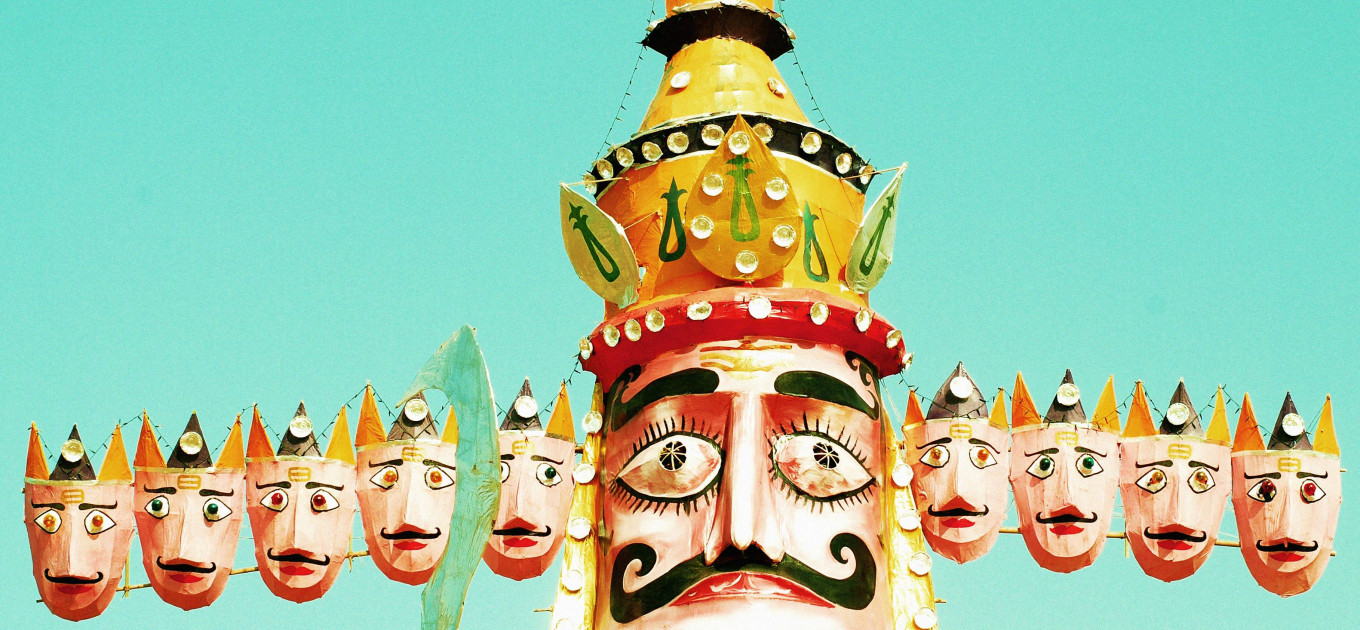
“I am too much liking Rahwana, madam,” he grinned, taking his hands off the wheels alarmingly and holding up 10 fingers. “Do you know that he is dasamukha? It means he has 10 heads.”
Pallavi Aiyar is a territorially polygamous correspondent, columnist, and author. She has reported from — and raised a family in — China, Belgium, Japan, Indonesia and Spain. She writes about the world with indiscriminate delight and a weakness for the surprising connections between people and places.