(Courtesy of MD Pictures)
Manoj Punjabi, the founder and CEO of MD Entertainment, Indonesia’s largest production house, is a rainmaker.
He’s sold over 100 million tickets throughout his career and is known to be the country’s most prominent hitmaker. In 2024, he released Ipar Adalah Maut (My Sister’s Husband), a family drama adapted from a novel with the same title, which sold over 4.8 million tickets in theaters. His other top contenders, KKN di Desa Penari (KKN: Curse of the Dancing Village), a horror story adapted for the big screen from a series of viral tweets by an anonymous writer using the pen name Simpleman, remains the number one horror film in Indonesia, selling over 10 million tickets.
Earlier this year, he released Danur: The Last Chapter, another adaptation of a horror story by Risa Saraswati, a popular Youtuber who began her career in music and later turned to novel writing, starring Prilly Latuconsina, one of Indonesia’s highest paid leading ladies. The movie sold over 3.6 million tickets.
In the entertainment industry, having a good nose for stories is key. Risks are often weighed based on how the right stories can generate good business. More than just a creative aspect, good storytelling is crucial in driving competition among filmmakers.
 The producer of Children of Heaven, Manoj Punjabi. (Courtesy of MD Pictures)
From sensation to simplicity

Thank you!
For signing up to our newsletter.
Please check your email for your newsletter subscription.
For years, Manoj Punjabi’s strategy has been to acquire huge and familiar stories or intellectual properties, actively involve the creators in the film’s marketing processes and cast well-known actors to play lead roles.
In 2008, he did exactly that when he adapted a best-selling novel, Ayat-Ayat Cinta (Verses of Love), onto the silver screen. Not only did he involve the book’s author, Habiburrahman El Shirazy, and the publisher in the film’s marketing outreach, he also cast Indonesia’s leading stars, Fedi Nuril, Rianti Cartwright and Carissa Putri. The movie became a national sensation, and almost 10 years later, a sequel was produced, Ayat-Ayat Cinta 2. Both films exceeded everyone’s expectations with total sales of 6.4 million tickets.
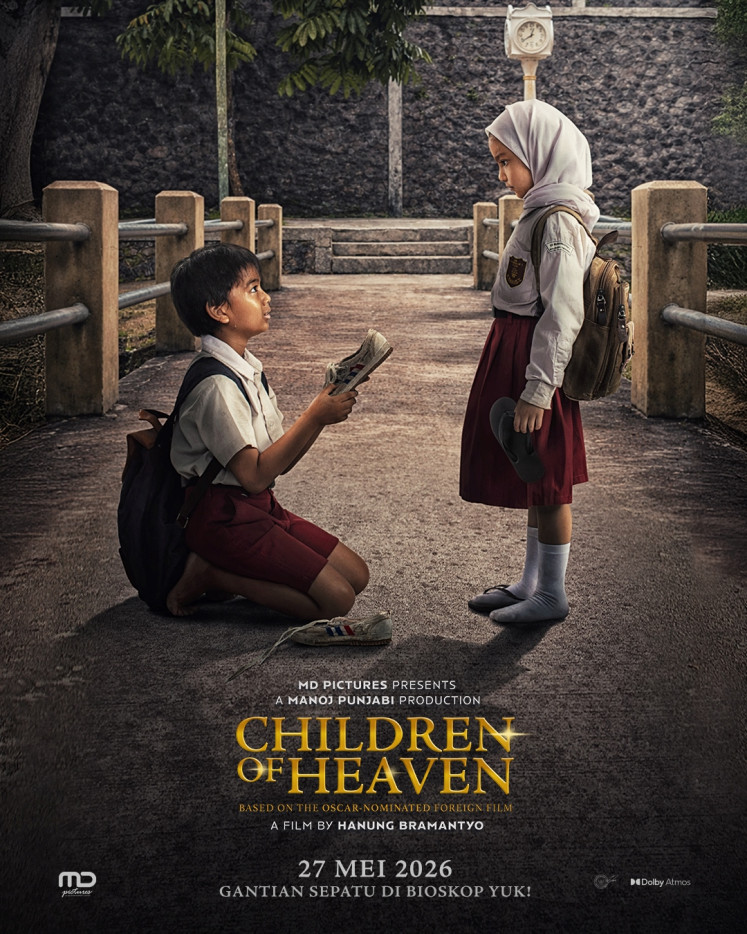
However, this Idul Adha holiday, he is doing something very different by releasing Children of Heaven, a remake of an Iranian sleeper hit directed by Majid Majidi released in 1997 that was later nominated for the Academy Award for Best Foreign Film.
The premise is simple: two siblings, a brother and sister, struggle over a lost pair of shoes. Shot in Tehran, the family drama ended up winning a slew of international accolades and is recognized as one of the best children’s films ever made.
On paper, this seems promising. But despite its worldwide recognition, for Indonesian audiences, Children of Heaven is not the sensational and emotionally immediate story that has traditionally driven Manoj Punjabi’s biggest box-office successes.
So, why did he choose to take this risk?
 (From left to right) Jared Ali (Ali), Manoj Punjabi, and Humaira Jahra (Zahra). (Courtesy of MD Pictures)
A quiet portrait of a changing nation
Children of Heaven was often aired on Indonesian national television in the mid to late 2000s. Marketed as a warm family feature, the film was dubbed in Indonesian for easier viewing, supposedly to allow people to follow the story even if they weren’t facing the screen. Many would attest that the film feels close and familiar, though when I talked about it on TikTok, nobody seemed to remember much about the production or even the title of the movie.
Those who have seen the film on their television screen only remember parts of the movie, such as the siblings taking turns wearing the one pair of shoes they had left, with the younger sister, Zahra, wearing them in the morning, and the older brother, Ali, in the afternoon.
This felt familiar to me, because back in those days many of the public schools across the country also relied on the double-shift system to maximize on infrastructure availability, allowing separate groups of students to access school facilities at different periods. Morning classes often lasted from 7 a.m. to noon; and afternoon classes lasted between 12.30 p.m. and 5.30 p.m.
Since today’s schools no longer apply the same system, to keep the story contextual and believable, screenwriters Hanan Novianti and Oka Aurora decided that the Indonesian remake of Children of Heaven had to be set in the year 1988.
The late 1980s were a significant milestone for the Indonesian economy. Following the oil price collapse in 1983, the country had expedited multi-pronged initiatives to remove itself from oil dependence to diversified manufacturing. The government began pushing for more exports, tax restructuring and making it easier for foreign investors to enter Indonesia, ultimately laying the groundwork for the country’s rapid industrial growth. As a result, the country experienced a reduction in poverty, and a massive upswing in the private sector, reshaping Indonesia’s economic landscape in the decades that followed.
Suffice to say, the creative choice to set the story in 1988 was not merely about nostalgia, but rather a deliberate attempt to place the characters within a moment of profound social and economic transitions in the country.
Director Hanung Bramantyo captures this through small gestures of kindness. When Ali and Zahra’s father struggles to pay his debts, their neighbor is quick to lend a hand. When Zahra struggles walking in her brother’s oversized shoes, another neighbor comes to the rescue and stuffs the shoes with a piece of fabric so they will fit her better.
This Indonesian remake aims to do more than just transfer the universal value of empathy, resilience and unconditional love, it also helps us contextualize the quiet anxieties and shifting aspirations of the country at the tail end of the 1980s.
As a film enthusiast myself, Manoj Punjabi’s latest move feels both groundbreaking and unexpectedly restrained. It is a rare departure from the commercially proven formulas that have long defined his success.
A different kind of bet
Children of Heaven may be a globally beloved family drama, but the entertainment scene in Indonesia is not typically driven by remakes of Oscar-winning films. Popularity often trumps the quality of stories, and at a time when more moviegoers are seeking thrills and adventures, the decision to remake this particular movie can appear somewhat counterintuitive.
“There’s an element of hope that the movie conveys,” said Manoj Punjabi. “The story is relatable because it’s about children’s basic needs.”
He elaborated further on the film’s premise and how the children’s response to their family’s economic situation is what drives him to believe the movie is not only relevant decades after its original release, but perhaps even more valuable in today’s climate of economic uncertainty.
Manoj Punjabi hopes the movie will give its audience a renewed sense of hope in navigating today’s socioeconomic challenges.
Commenting on the lack of star power in the film, Manoj Punjabi dispelled the notion that he’s only interested in working with actors who maintain household-name status. On the contrary, he believes actors are chosen by the characters on the page.
“Stars only bring value if the roles are right for them,” he said. “And in this movie, Ali and Zahra are the stars.”
Ali is portrayed by Jared Ali who has previously appeared in Tinggal Meninggal (Better Off Dead), while Zahra is portrayed by Humaira Jahra who was previously seen in Patah Hati yang Kupilih (The Heartbreak I Choose).
 (Courtesy of MD Pictures)
More than a remake
Most of the time, we watch movies to escape reality and enter their fictional renditions. However, films like Children of Heaven work differently, slowly returning us to the emotional gravity we often overlook in our own everyday lives.
Plenty of movies have tried to tackle the issue of poverty and its social consequences, and the local movie scene is not in short supply when it comes to these stories. Manoj Punjabi’s move to add a new narrative to the genre may be seen as risky, yet that is precisely what makes it worth watching.
This movie is not about creating a major spectacle like other films Manoj Punjabi has produced, and its ambition appears to be less about ticket sales and more about moving its audiences into a space of hope, resilience and kindness. By remaking the film, Manoj Punjabi is sending a clear message to all of us: there is always room for stories that remind us of our shared humanity.
As part of the film’s marketing campaign, MD Entertainment Foundation is collaborating with nonprofit platforms and organizations like Kitabisa, Tangan Pengharapan and Rangkul to collect and distribute shoes for those in need.
Perhaps the remake will add a new dimension to Manoj Punjabi’s career as a rainmaker, proving that commercial instinct and genuine emotional depth do not always have to be at odds with each other. And maybe this risky move will mark the beginning of a second golden age for Indonesian cinema.
Children of Heaven is set to release on May 27.
Reza Mardian is a winner of the Best Film Critic award at the Festival Film Indonesia 2024 and a “pawrent” to two rescued cats. He writes screenplays every time he finishes rewatching La La Land or Lady Bird.