(Shutterstock)
How much does it cost to run a household in Jakarta? According to the 2022 Cost of Living Survey from Statistics Indonesia (BPS), the latest edition of the quinquennial survey, the average Jakarta household spends Rp 14.88 million (US$834) a month.
Adjusted for inflation over the four years since, that figure likely exceeds Rp 16 million today. Housing alone, including water, electricity and gas, accounts for over Rp 3 million.
The gap between what the statistics say and what the 2026 minimum wage of Rp 5,729,876 can cover does most of the explaining for why so many people in this city feel like they're running in place.
So, does moving in with a partner help? Financially, not as much as you'd think.
What two incomes actually buy you in Jakarta isn't necessarily a more affordable life. It’s something more resilient and harder to quantify: The feeling that the city is more manageable, that you're not going it alone.
Four couples at different life stages and income levels have opened up their finances and their thinking in trying to address this question.

Thank you!
For signing up to our newsletter.
Please check your email for your newsletter subscription.
What they have in common aren’t figures, but that almost all of them are working toward owning a home and consciously saving money in a city that makes both difficult.
They’re also clear that sharing the weight of living in Jakarta with a significant other has changed how the city feels, even when not much has changed about what it costs.
James & Dana: Thinking ahead
Two weeks after moving in together, this couple is still sorting out whose stuff goes where and already having the kinds of financial conversations most avoid for years. The move has changed not only their address but also how they think about the future, together.
James and Dana are two weeks into sharing a kos (rooming house) in South Jakarta, still in the thick of pooling their assets, hopes and dreams.
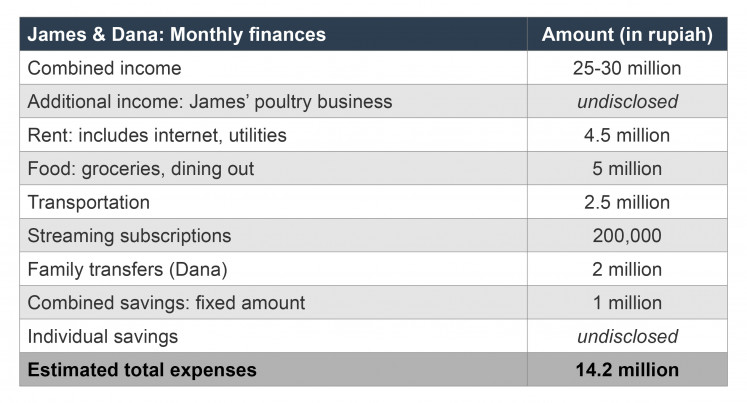
Dana is 25 and an advertising executive; James is 32 and a marketing officer with a poultry business on the side. Together, they bring in around Rp 25-30 million a month. They're still trying to work out what financial arrangement works best for them.
"We've agreed on how to split the rent and cover basic necessities like groceries, but beyond that, we're still figuring things out as we go," Dana says.
For now, James handles the bigger fixed costs: Rp 4.5 million for rent, which includes the internet, water and electricity, plus Rp 200,000 a month for Netflix and Prime Video subscriptions.
"I'm very picky about choosing where we live. The place has to be very accessible to public transport and near supermarkets,” James says.
“I'm also very picky about landlords. In the past, I got a headache from my landlord and his many complaints," he adds, noting that the couple’s current kos is more suitable.
He also covers date nights, when they happen. Dana contributes around 30 percent of the grocery bill and transfers Rp 2 million a month to her parents, a financial obligation she carries alone.
The one thing neither of them is willing to compromise on is food. The couple spends up to Rp 5 million a month on eating, and James is unapologetic about it.
"We didn't think that much when it came to the price of food, because a happy tummy equals a happy life," Dana laughs. "So yeah, we didn't think much about the spending as long as it still works within the budget."
Both came in with their own savings accounts. A shared fund is new and still small, but they've agreed on a fixed monthly contribution.
"It's still a small step, but it feels important because it reflects our commitment to planning ahead and being more intentional about our future," Dana says.
Their goals may not overlap perfectly (James wants to buy them a home while Dana is building a financial cushion for an eventual career change), but they're not treating these as competing priorities.
"Now that I'm in a relationship and we've started talking seriously about building a future together, my priorities have shifted. The amount I need to set aside for savings has increased, so I can't just spend on things for my own pleasure anymore without thinking it through," James says.
They might not have come up with a solution for Jakarta living yet, but they've started having the conversations.
Kevin & Lily: Eating well
Four months at a Kuningan apartment, this couple is managing ongoing talks about food costs and a combined income that’s disappearing faster than either of them expected. And the biggest budget line isn't rent; it's dinner.
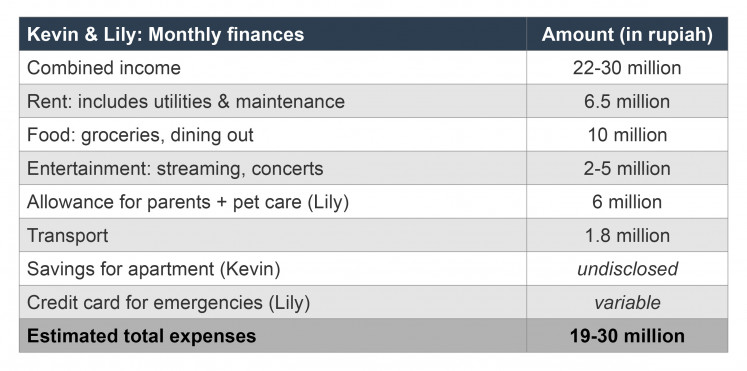
Lily and Kevin, both 32, have been living together for around four months in an apartment in South Jakarta’s retail hot spot Kuningan. The combined income of the executive assistant and data scientist runs Rp 22-30 million a month.
Ask either of them what their top priority is and the answer is immediate: food. Kevin usually covers groceries, but cooking is something they do together. Their total spending on food, including dining out, runs to around Rp 10 million a month: a figure Kevin has clearly spent time thinking about.
"The biggest struggle is balancing between cooking and eating out, since cooking takes time that can be used for something else, but eating out is multiple times more expensive than cooking," he says. They haven't resolved this dilemma so much as learned to live with it.
Rent comes second: Rp 6.5 million a month for an apartment where water, electricity, gas and maintenance are all inclusive. They're happy with the arrangement for now, but Kevin has his eye on something more permanent. Owning an apartment is at the top of his list of long-term goals, right next to marriage, and he's already opened a separate savings account in his name toward that.
Transport and gym memberships are handled separately. The couple sets aside Rp 2-5 million a month for entertainment: streaming services, concert tickets, nights out. For anything unexpected, Lily has her credit card, while Kevin keeps a separate safety net.
For Lily, the third big financial obligation is family. She has been supporting her parents since she entered the workforce six years ago, covering their groceries and housing costs. She also looks after her cat Birong to the monthly tune of around Rp 600,000.
Neither of them says that moving in together has dramatically changed how they spend individually. Their priorities were arranged before moving to Jakarta, where they had always been set on living, no matter the income.
Lily spent years working in Semarang, East Java, before deciding to move back.
"I decided to come back because my parents and my friends are here,” she explains.
“When you work here, even though it's really crowded on the streets, everything is still reachable. You can easily find public transportation or even go to the airport."
And gaving someone to share the city with has just made it all a little easier.
Ali & Manda: No budget, no problem
A studio in Kemang, no formal budget and a safety net in Bekasi they're not ready to use yet, this couple has the lowest combined income and is the first to admit their system is loose, but it works somehow.
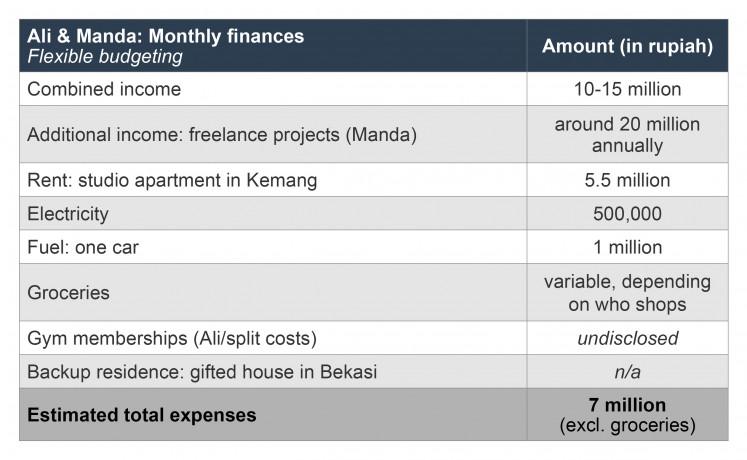
Manda, 34, and Ali, 36, have been married since around mid-2021. She works as a marketing manager; he's in the technology sector. They live in a studio apartment in Kemang, South Jakarta. They bring in around Rp 10-15 million a month together, though Manda supplements this with freelance work two to three times a year.
Of all these couples, Manda and Ali come closest on paper to BPS’ average household expenditure. They're also the most candid about how they manage it: They don't.
"So basically, we don't do budgeting. We're not that good in finance," Manda laughs.
In practice, their arrangement is entirely fluid. Rent is Rp 5.5 million, which they usually split evenly. Electricity runs around Rp 500,000. Ali typically buys gas for the car. Groceries are covered by whoever happens to be shopping that week.
"Sometimes I cover 70 percent," Manda says. "For much of this year, I covered all of it because his business is slowing down."
They have no formal agreement, just an ongoing adjustment based on who has more at any given moment.
"My husband and I have the same principle," she says. "Sometimes, saving money is not discipline, it's more of a luxury."
Outside of necessities, they take occasional road trips to Bandung, West Java. Gym memberships fall to Ali or are split. There's no entertainment budget, just spending that happens and gets absorbed in the month’s costs.
What gives this arrangement its low-key confidence is a safety net: They have the option of moving to a house in Bekasi that Ali’s parents bought for them, with financial support if needed. They're not ready to take it, though, since both want to stay closer to the city center for now. But knowing it’s there takes some of the edge off.
"We don't spend a lot of money. I'm not into branded stuff or anything. We do eat a lot and it's out of control. Even our groceries, because sometimes he's really specific. He doesn't want white rice. And if it's red rice, it has to be something else," Manda says, laughing.
Their short-term goal is a house: something they choose in a neighborhood where they want to live.
Manda is clear that the pressure hasn't shifted much since she was single. What has changed is that she's not carrying it by herself.
"We want to save more this year, but we still have it a bit more relaxed than other couples, I suppose," she says.
When one of them is having a harder month, the other adjusts. Jakarta might be expensive still, but it's less lonely.
Saul & Eve: Separate wallets
Married a year ago and living in Grogol, with separate bank accounts and a stipend arrangement that works for them, Eve finds marriage has made the city feel more manageable.
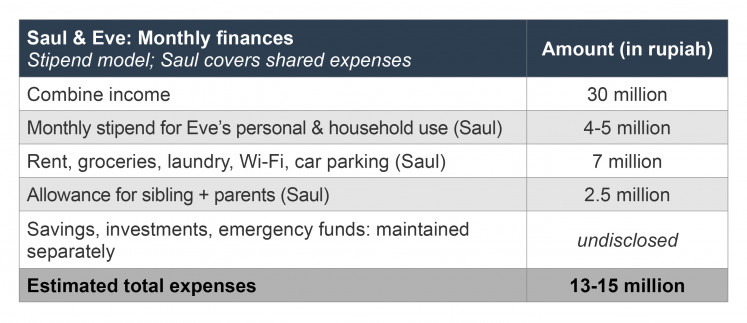
An apartment in Grogol, West Jakarta, is home to state employee Saul, 31, and his wife of one year, Eve, 27, who works in the creative industry. Their financial setup is clear, if a little unconventional, in structure: They keep almost everything separate.
Eve earns Rp 9 million a month, which Saul tops up with a monthly stipend of Rp 4-5 million: not as a contribution for shared expenses but as an allowance for her personal and household use.
"So, the stipend is really money for food, for buying things like toiletries, things like that. Personal and household stuff. For example, if you need to buy a broom," she explains.
Saul handles everything else: rent, groceries, laundry, Wi-Fi, parking. He also sets money aside for his younger sister's tuition and allowance. Eve admits she doesn't track exactly what he spends.
What she does know is that it works. Before she got married, saving money in Jakarta felt like a constant struggle.
"What we can say is that Jakarta is more livable after we got married, because we can split [the costs] in two. Before, we struggled to save money, but after we shared some of the burdens together, like he pays rent while I pay for the utilities, it's become more livable," she says.
As for discretionary spending, Saul takes care of their dates, from weekend getaways to a simple night out for ice cream. Eve is not a fine dining person, which she describes as "unwise" spending, and prefers a balanced meal cooked at home.
"My husband and I ended up negotiating when to splurge and when to save so that even when we eat out, I can be at ease and he can be happy seeing me not worrying about money and nutrition," she says.
Their savings, investments and emergency funds stay separate, too. Eve has a clear personal plan: mutual funds, possibly some foreign exchange. What Saul does with his savings is his own business.
"I don't think I can really dig in or speak on it because it's private," she says.
For now, their goal is stability. A house is further down the list, deliberately so.
"Because we're afraid of unforeseeable circumstances, like what if our office moves to another location? When we have a house, we know we'll be there forever," Eve says.
They want the option to move if they need to. For a couple in their first year of marriage and of figuring out a new city together, that kind of flexibility still feels like an asset worth keeping.
What does sharing actually buy?
None of these four couples lives comfortably on the Rp 14.88 million average household spending quoted by BPS, which is outdated anyway. Today’s ballpark figure is closer to Rp 16 million or more.
James and Dana have inched past that and are still building toward their future; Kevin and Lily spend Rp 10 million on food alone. Saul and Eve make it work by separating their finances and being clear-eyed about who’s responsible for what. Ali and Manda get by on the loosest possible system, held together by goodwill and a backup plan in Bekasi they'd rather not use.
What they have in common is not strategy but strategic direction. Almost all couples are working toward owning a home, which would make them feel more settled in a city that has a way of making its inhabitants feel just one emergency from the edge.
Owning a house also means graduating from renting and deciding to stay here.
In varying ways, almost all say that sharing Jakarta with someone has changed how the city feels: not cheaper, but less like something they're fighting alone.
Eve puts it most plainly: saving money felt like a constant struggle as a singleton, but after she and Saul got married, it was something they could figure out together.
That might be the most honest answer to the question of what two incomes can actually buy a couple in Jakarta.
Sheena Suparman is a writer for The Jakarta Post's Creative Desk. She is based in Jakarta but wishes she could be anywhere else. She’s usually powered by coffee, chips and cheeseburgers.