(B/NDL Studios/Budhi Button)
People love to ask which part of Jakarta you live in.
If your address is in South Jakarta, or Jaksel, then you're either trendy if you're in Senopati or Blok M, or old money rich if you're in Pondok Indah.
You're "from the hood" if you live in East Jakarta (Jaktim) or if you're from the north, specifically the Tanjung Priok area. But if your house is in the gleaming Pantai Indah Kapuk side of North Jakarta, you're rich rich.
Like 90210 for the upscale Californian city of Beverly Hills, living in an area with the postcode 12310 (for Pondok Pinang in Kebayoran Lama, South Jakarta) immediately says something about you. But that's a very macro, very TikTok point of view, because a 12310 postcode can mean you live on the same street as Inul Daratista or in a small cabin just five minutes away. In Jakarta, contrasts are as omnipresent as pollution.
The address, though, makes little difference when it comes to what living in the city actually costs: Jakarta is expensive everywhere.
Born and raised here, I've lived in multiple spots across the city at different life stages and income levels, and I've come to this conclusion: This city is expensive for what it can offer.

Thank you!
For signing up to our newsletter.
Please check your email for your newsletter subscription.
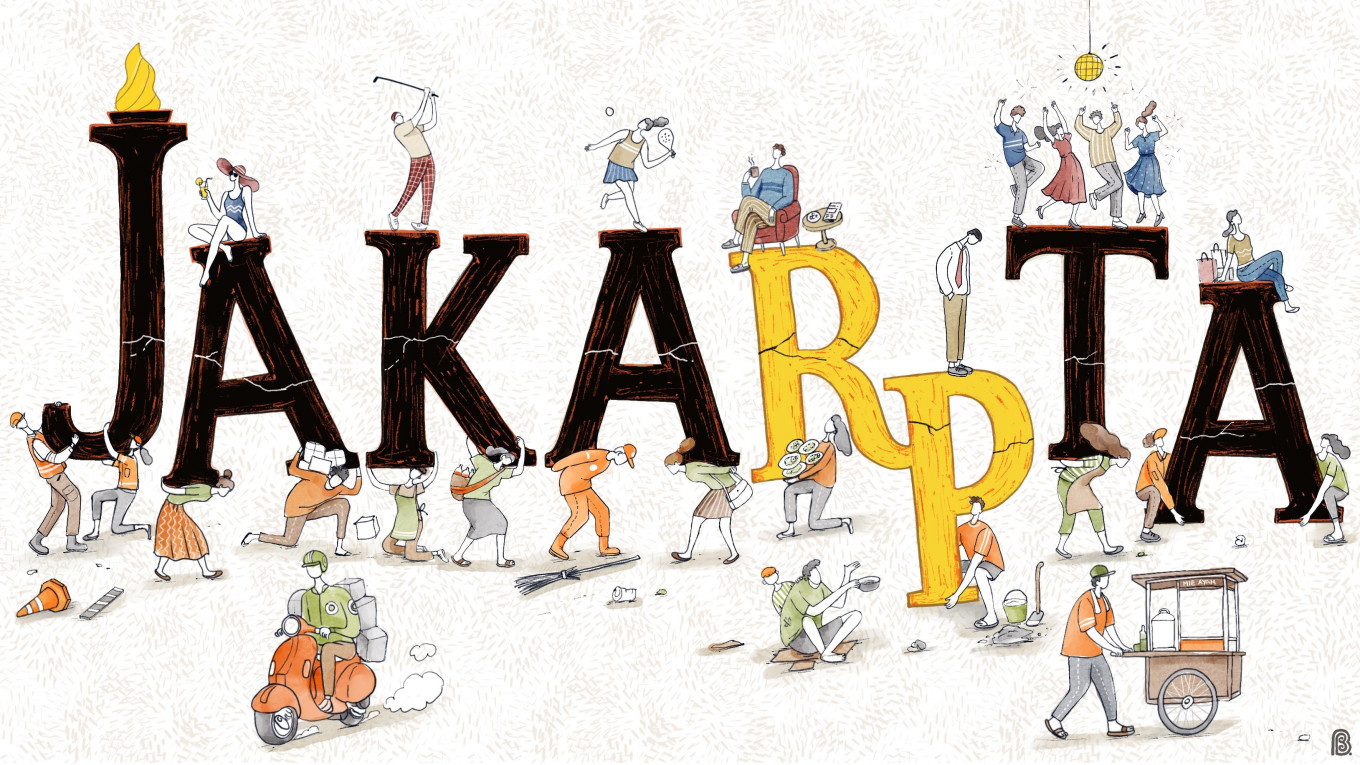
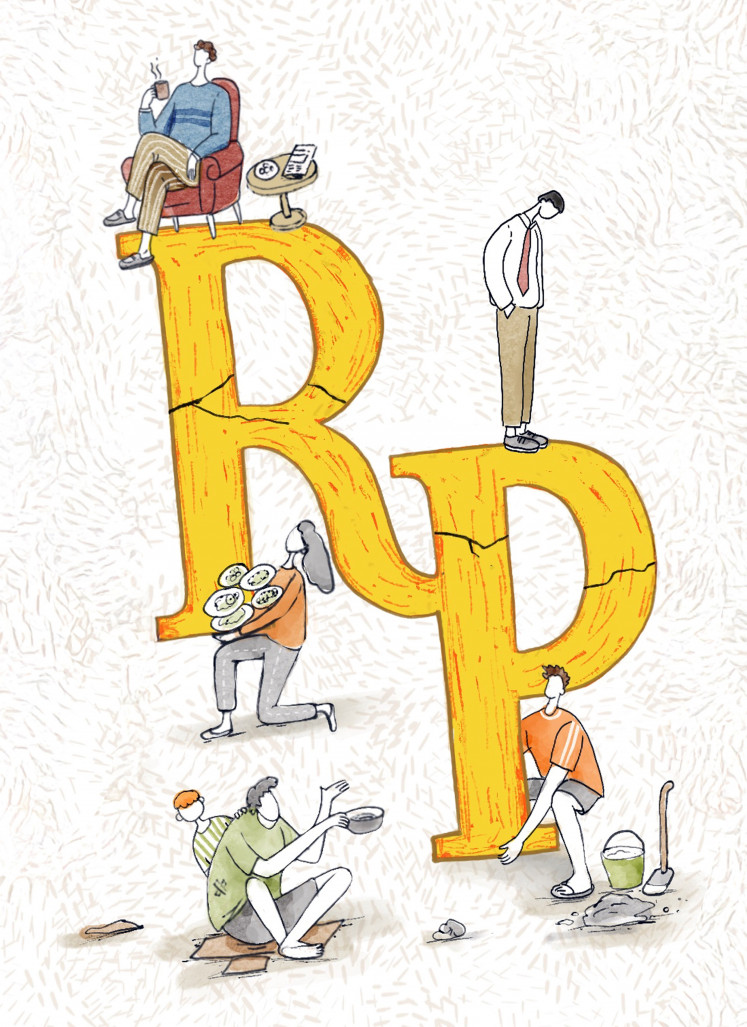
The only real choice is what you're willing to pay with: your money, your time or your sanity.
Where you live matters
Housing, in my experience, takes the biggest cut. Rent and utilities run around 20 percent of my monthly income, but that's a conscious choice I've made. I like the freedom and flexibility of living near the city center.
On bad days, a 20-minute ride from the Sudirman Central Business District (SCBD) to Tebet can run up to an hour and a half, but I still take it as a win compared to doing that daily if I moved back to my mom's place outside the city center.
Money is what I sacrifice; some people give up time instead.
Paramitha, 27, didn't really get to choose. She commutes two hours by public transport each way from Teluk Gong in North Jakarta to her office in South Jakarta’s Blok M area.
She used to rent a room in Cipete, which was closer to work. But when her office cut back on overtime, the math stopped making sense so she moved back home.
When she was renting, her numbers were very tight. Her single room cost Rp 850,000 (US$48) a month, no air conditioner. On top of that, she was paying around Rp 2 million in tuition, all on a salary below minimum wage. What was left was what she had to survive on.
"I had to manage. Sometimes, I had to borrow from next month's salary just to get by," Paramitha recalls.
When she was renting, she was paying with money she didn't have. Now she's paying with a four-hour daily commute, and she's decided it's the better deal, because at some point during those tight months in Cipete, she was paying with her sanity, too.
"Money-wise, I swapped rent for helping out with groceries and utilities at home. It's nicer and safer, though," she says.
"Living on my own, you're freer, sure. But now I don't have to be alone. Especially when I'm sick. I have people who take care of me."
Tika hasn't left home either, not because she can't afford to but because she ran the numbers and they didn't add up to anything worth the trouble. Forty and single, she lives in her childhood home in Pondok Pinang with her mother and grandmother. The drive to her office on Jl. Gatot Subroto takes around an hour.
She shrugs at this. Everything in Jakarta is an hour away anyway, we laugh.
"I can use my money for things that matter more to me than buying my own place, like traveling," she says.
"I have my own space at home and it's comfortable enough. If I want more alone time, I can always travel."
Tika did consider living alone, but only under certain conditions: "The calculation says it's more comfortable at home," she says.
Cost is the main factor but not the only one. Being close to her family has given her something she didn't expect.
"It's been eye-opening. It helped me understand the relationship between my mom and my grandmother," Tika says.
That said, family life as an adult child is not without friction.
"Well, like they say, we pay with our mental health," she laughs.
"But over time, I learned how to manage. That's the philosophy of living in Jakarta: Focus on what you can control. A lot you can't, so you do what you can to stay zen.
“It's like traffic. I can't control it, but I can control what I do while I'm stuck behind the wheel."
“That's the philosophy of living in Jakarta: Focus on what you can control. [...] It's like traffic. I can't control it, but I can control what I do while I'm stuck behind the wheel.” — Tika, resident of Pondok Pinang, Kebayoran Lama, South Jakarta
Your priorities matter
Different life stages bring different math.
Fransiska, 34, is married and has a daughter. Her income mostly supports her family, and she has discovered that a child costs approximately as much as a full-size human.
She puts 80 percent of her salary into a joint account to cover household expenses as well as her daughter's. Her income has grown over the years, but so have her expenses.
"Why does living in Jakarta feel like no matter how hard we work, we can't get rich? It's all just survival, even at my current income," Fransiska says.
"Just to have a decent life, we have to pay so much."
We then spent a good 30 minutes comparing how public facilities, education and health are subsidized by governments in Singapore, the United Kingdom and Australia.
That's a conversation for another day, but it reminded me of my own time abroad: In London, I spent 50 pounds ($67) on groceries at Sainsbury's every two weeks, which totals roughly Rp 2 million a month: around what I'd spend on a monthly grocery run at Grand Lucky. Until now, this still does not make sense to me.
Fransiska spends at least Rp 18 million a month on her daughter alone, a third of the total household budget, which covers insurance, kindergarten, gymnastics, swimming, English classes, violin lessons, a domestic helper, weekend playground visits and savings.
That's before food and transportation. On top of that, she still has to budget for mortgage payments, her parents, her own costs and more.
"Why does living in Jakarta feel like no matter how hard we work, we can't get rich? It's all just survival, even at my current income" — Fransiska, resident of Pulomas, Pulo Gadung, East Jakarta
"She starts elementary school in two years, so this figure is going up," she says.
"What I've just realized is how expensive children's social costs are. For ourselves, we can manage. I can tell my friends I don't want to go out or that we have to wait until payday to try that restaurant. They'd understand. You can't give that kind of reasoning to young kids."
There are playdates, birthday presents for 15 classmates and eventually, a birthday party to host in return.
"We make do. The things we do for our kids. We learn to shift other expenses around for her needs."
She pauses. "She goes to a local Catholic school now. I can't imagine what it'd be like if it were a high-end [school like] Montessori."
For Fransiska, the priority is giving her daughter a comfortable life and being present in it. That's why she recently moved back to her parents' home in Pulomas and shifted jobs from Bogor in West Java to Sunter, cutting her commute to be closer to home.
"I lost three years of my daughter's golden period when I was working at a start-up. Now I'm chasing work-life balance to make up for it."
She was paying with time when she was commuting to Bogor, now she's paying with money. The sanity part, she's still working out.
Living with her parents means more support, more time with her daughter and an opportunity to be there for her parents, too. She already has a mortgage on a property in East Jakarta’s Cakung she has to see through, but she's reframed it as an investment: something to rent out, something to leave her daughter.
For Tika, the goal used to be buying a house. Then she looked at property prices and maintenance costs, ran the numbers and changed her mind. The urgency to move out wasn't there, so her priorities shifted.
"I have my emergency fund. I'm not too ambitious with investments so I take a long-term approach, and I'm trying to grow my savings," she says.
In the meantime, she spends on good food, wellness, health and experiences: Things that are, by her calculation, worth it.
Paramitha is at a different starting line. She graduated a few months ago, so the tuition line has disappeared from her budget and she can finally breathe a little. A new job offer and a higher salary mean she can save for the first time.
Her first goal is a real vacation, something she's been putting off for as long as she can remember: Bali first, or maybe even Hong Kong.
 (B/NDL Studios/Budhi Button)
Your choices matter most
Four women, four different incomes, four different versions of making it work in this city. The number on the pay slip matters; of course it does, but it doesn't tell the whole story.
What you do with it, how you arrange your life around it, what you're willing to trade and what you refuse to: These are what determine how much it really costs to live in Jakarta.
"Living in Jakarta is all about mindset," Tika says. "It's not surviving but adapting. You choose your lifestyle: low, medium or high."
Her strategy is to splurge on what matters most (experiences) and cut back on what doesn't (trendy shoes, bags, trinkets). When she does buy, she opts for fewer, better things that last.
Paramitha's approach is more tactical. She does her shopping during monthly e-commerce flash sales, compares prices across multiple platforms and only buys from stores that offer free shipping.
She also signed up for Kartu Pekerja Jakarta (Jakarta Workers' Card), which gives her free rides on TransJakarta and the Jakarta MRT. She is making the most of every opportunity to save.
None of this is revolutionary advice, but in a city that's very, very good at separating you from your money, knowing when to say no to that is the closest thing to a superpower you'll get.
So how much do you actually need to earn to live comfortably in Jakarta?
The official figures don't help much. Statistics Indonesia (BPS) puts the average per capita spending in South Jakarta at Rp 3,274,714 a month. Numbeo, the global cost of living database, says a single person needs Rp 8,345,312 to live here.
Same city, very different math, and both figures exist in a city where the 2026 minimum wage sits at Rp 5,729,876 and many residents still earn below it.
That gap between what the numbers say and what life actually costs is where most Jakartans live.
My own middle-class answer to the question above is somewhere around Rp 20 million a month for a single person, excluding housing.
Fransiska figures much higher: Rp 30 million for a single person, Rp 45 million with a child, not counting a partner's income. Tika estimates Rp 15-20 million, excluding rent.
We are all more or less in the same ballpark, which is either reassuring or depressing, depending on how you look at it.
Paramitha has the wisest answer of the four of us, and she's the youngest.
"I think whether it's enough or not depends on control," she says.
"Our parents didn't know self-reward the way we do now, and they survived. Now with a higher salary at my new job, I have to control myself.
“Yes, maybe I can set a little aside for things I haven't been able to afford before. But in general, I want to keep my current lifestyle so I can start saving. If I decide to spend it all at cafes, it will just disappear."
She's right, and it's annoying that she's right.
There will always be more to chase in Jakarta: a bigger salary, a better neighborhood, a lifestyle just slightly out of reach. The city is designed to keep you wanting.
But if you can figure out what's actually enough for you, not what the algorithm shows you and not what your colleagues seem to have, that clarity is the closest thing to a winning strategy in this city.
Knowing which “currency” you can actually afford to spend and which one's already running out turns out to be the most important financial literacy lesson Jakarta teaches. Nobody puts it in the budget spreadsheet, but everyone's paying it.
Adelia Anjani Putri, a communications consultant and former reporter, has found herself writing again. She’s also exploring a career shift that would let her pursue her passions for cooking and catsitting—ideally with a paycheck.