(Shutterstock)
It takes a very special moment in time to make sipping an iced vanilla latte feel like committing an unforgivable sin.
The thought struck me as I walked around the neighborhood mall, scouting for a cozy spot to plug in and do some light editing. It was the 25th, or the day of reckoning for Jakarta’s white-collar workers, when sweat, tears and spreadsheets finally resolve into a direct deposit.
Yet the usual lunchtime crowd was nowhere to be seen, and those who did eat out savored their payday meals in private, tucked behind convenient yet conspicuous curtains.
It was just one-and-a-half weeks into Ramadan, and collective piety seemed to be going strong.
As someone raised Muslim, I am fully aware of the grave transgression of hem-and-hawing between a croissant or a brownie to accompany my midday beverage.

Thank you!
For signing up to our newsletter.
Please check your email for your newsletter subscription.
Nevertheless, my mother’s words from years ago still ring in my head as I scanned the cashier’s QR code: “Why do you starve yourself for a specific month when you don’t even pray every day?”
Performing virtue
I was raised in a religious-adjacent household, where faith is visible but not enforced.
My grandparents observed the five pillars of Islam; they raised their children as Muslim, prayed five times a day, paid their zakat (obligatory charity) on time, fasted when their health allowed and eventually went on the hajj.
My parents were less observant, but still made an effort to internalize Islamic values and virtues to the best of their abilities.
Despite their different approaches, both generations agreed that faith is ultimately a private matter, and that your relationship with your deity of choice is between you and that deity alone.
They didn’t push me to learn the good word, preferring I come to my own conclusions rather than be railroaded into submission.
As that’s still quite an unusual arrangement in a country where asking about your religion remains an acceptable ice-breaker, I learned to smile politely, recite the right verses and memorize the prayer steps until it becomes muscle memory.
You could say that putting on a performance, for many, is an act of courtesy, or even survival for some. And nowhere is this more apparent than during the holy month of Ramadan, where the vaguely Middle Eastern decor and Arabic songs in mall lobbies herald the biggest stage of the year.
Performing communality
Fasting in a religious context is not unique to Islam, but it is arguably the most visible ritual in the world’s most populous Muslim-majority country come Ramadan, especially when the curtains are closed shut, karaoke bars shutter for the entire month and alcohol is entirely off the table in some establishments.
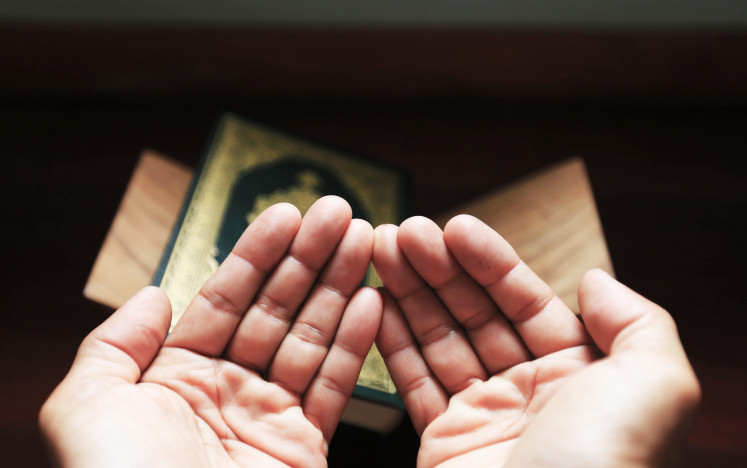
The rationale, of course, is righteousness and godliness, as fasting is believed to purify the soul. Surah Al-Baqarah 2:183 is clear: “Fasting is prescribed for you—as it was for those before you—so perhaps you will become mindful [of Allah].”
 (Shutterstock)
Yet in performing this ritual, the body becomes a public display of devotion. Not reaching for your tumbler or lighter during lunch break is arguably as visible an act as stealthily devouring a plate of brownies with the blinds drawn shut.
Just as the philosopher Judith Butler postulated that gender is constructed over time through a series of actions and behaviors, perhaps religious identity works the same way. We become what we perform, over and over, until the performance and the person are hard to tell apart.
But when 87 percent of the country collectively synchronizes their eating habits and sleeping schedules, “I am fasting” quickly becomes “we are fasting”, and deviating from the script marks you as an “other”. Doubly so if you’re supposed to be part of that 87 percent.
I still remember my peers quizzing me in school about how many days I’ve fasted, all in the same tone they use to ask about my Snapchat streak. Even in a secular suburban neighborhood, faith has become social currency, or at least for that month.
Long after the diplomas have been filed away somewhere, I still hear the same question thrown around as a conversation starter, often followed by a faux-modest quip about how it’s not easy for them to rein in their impulses too.
After sundown though? Munchies, ciggies and other saucy stories as usual, until 4.30 a.m. rolls around again.
Sincerely performing
In hindsight, it is weirdly competitive, performative, even, to ask someone how their faith is holding up, even if it comes from a good place.
When my mother asked me that question all those years ago, she did so after seeing how my father’s insistence on fasting led to a brief health scare. But underneath all of that, it was also a question of sincerity.
In his exegesis of the Surah Al-Baqarah verse, the 14th-century Muslim scholar Ibn Kathir emphasizes fasting as being done with the intention of doing so sincerely for God and God alone.
Critically, the Pakistani scholar Idris Kandhlawi’s Ma’arif al-Quran points out that abstaining from food and drink throughout the day without the intention to fast invalidates the entire process. As such, the onus is on the individual to consciously make the decision to fast.
When my friend group abstained from our regularly scheduled lunch-slash-gossip session during Ramadan, perhaps I only went along because it was what the others were doing. I wanted to fit in. To belong. To not be seen as a godless harbinger of the end times. I barely talk to those friends now.
 (Shutterstock)
To my mother, picking the parts of a religion that suited me while conveniently ignoring the rest seemed like a cop-out. A shortcut to surface-level acceptance, cosplaying piety for middling brownie points that’s not as delicious as the real brownie I’m finishing as I type this down.
You can’t find a dupe for devotion, after all. And violating that sanctity is probably even more of a sin than sipping on a latte during fasting month, even if it’s away from prying mortal eyes.
The question she asked was simple. I couldn't answer it then.
I still can't, not entirely. But I understand it better now.
I don’t pray five times a day, for the same reason that going through the motions without genuine intent feels, to me, more disrespectful than not going through them at all. And if I'm being fully honest, my urge to fast has sometimes had more to do with fitting into a pair of jeans than fitting into a social circle.
That doesn’t mean I don’t believe. I do, in my own unresolved way. But as my mother implied, you either go all in or not at all. And that commitment is something I’m not ready to make yet. I don't want to hollow out something sacred just to perform it.
The higher power, I suspect, will still be there when I’m ready.
Until then, I’ll be at the café. And if you take offense, well, mohon maaf lahir batin.
Josa Lukman is an editor and head of the Creative Desk at The Jakarta Post. He is also a margarita enthusiast who chases Panadol with Tolak Angin, a hoarder of former "it" bags and an iced latte slurper.