(Shutterstock)
How much do you need to raise kids in Jakarta? It's nerve-wracking once you start doing the math, accounting for everything from tuition and after-school activities to emergencies you can never fully plan for.
I talked to four families with different income levels, ranging from Rp 26 million (US$1,400) to Rp 125 million a month, to try and answer this question.
From these conversations, it appears that a combined monthly income of Rp 20-50 million is the functional range for raising children in Jakarta. That figure, however, doesn't account for what one parent describes as variables related to "comfort, health or freedom" that quietly inflate budgets, nor does it cover the anxiety shared by all four families that whatever they're doing now may not be enough for whatever comes next.
Regardless of income, one thing was consistent: Education is top priority. But the more revealing aspect isn't how much families spend on their children's education; it's what they believe they're buying.
One father enrolls his toddler in a Cambridge preschool and plans to follow that track all the way through senior high. Another explicitly rejects international curricula, preferring a local education that doesn't put parents in a position to intimidate teachers.
A third is already saving billions of rupiah for possibly sending his children to a secondary school abroad. And a fourth has deliberately built a modest life for their family on the belief that good parenting doesn't need expensive schooling for validation.

Thank you!
For signing up to our newsletter.
Please check your email for your newsletter subscription.
Alya: Suburban comfort
A young family of four is living well in South Tangerang, Banten, managing two incomes, having open conversations about money and with the rare advantage of a home they fully own.
For Alya and her husband, financial management requires a spreadsheet. Every two months, they sit down and write out how much each will contribute to household expenses and how much they plan to spend.
"Being open and honest about our finances has helped us a lot," she says.
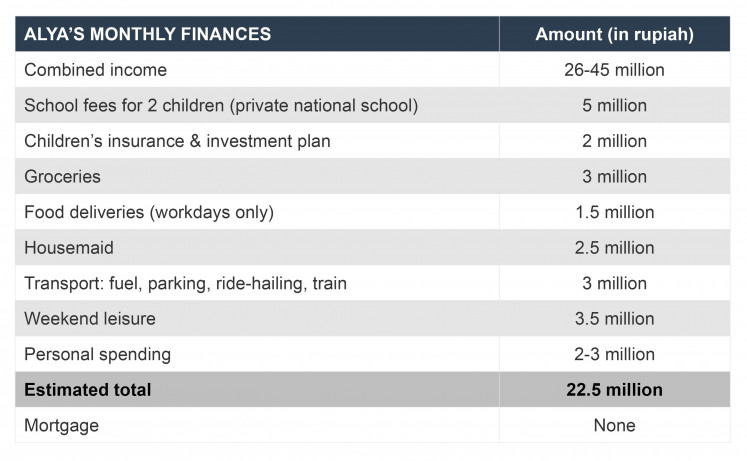
Alya, 40, works full-time in Jakarta as a project manager, while her husband runs a digital marketing company. Together they bring in Rp 26-45 million a month, which she finds more than sufficient to cover two children and a housemaid. They live in South Tangerang on land she inherited from her parents.
"We built our house seven years ago so thankfully, we have no mortgage now," she says.
Since Alya works every day, having a housemaid is a necessity, not a luxury. She pays Rp 2.5 million for her household helper, who handles the morning routine: helping the children get ready, dropping them off at school, cooking, cleaning and doing the laundry.
"But I also split tasks with her. If I have the time and energy to mop the floor, I'll do that," she says.
The family owns a car and a motorcycle, spending roughly Rp 3 million a month on fuel, maintenance and parking, as well as for Alya's daily commute by ride-hailing and train.
Groceries run Rp 3 million a month, though Alya and her husband often skip dinner. She also budgets Rp 1.5 million for online food deliveries on workdays: This is the first thing she cuts when she needs to save.
Education gets the biggest allocation. Their children, aged 10 and 6, attend a private national school built around educator Stephen Covey's seven habits, at a monthly cost of Rp 5 million together.
Both children are also enrolled in a combined insurance and investment plan, into which Alya pays around Rp 2 million each month. She hopes it will yield at least Rp 200 million by the time they're ready for university.
On weekends, the family goes running together in the nearest car-free zone. "Malls are too crowded nowadays," she says. Their weekend spending averages between Rp 800,000 and Rp 1 million.
Things weren't always this steady. During the COVID-19 pandemic, her husband lost his job and their income dropped by more than half. Monthly groceries shrank to Rp 300,000-400,000 for a household of five, including the maid.
"Surprisingly, it was doable," she says, recounting her strategy of cutting out frozen foods and cooking from scratch instead.
Even with their comfortable income now, Alya checks the spreadsheet before any discretionary purchases.
"I communicate almost everything to my husband, including if I want to buy a new padel racket or sportswear. We'd look at the spreadsheet to see if it's something we can afford now or should wait."
They put aside around Rp 2-3 million a month for personal spending, though it's rarely fully spent.
On the question of dividing finances, Alya contributes 30 percent of her income while her husband contributes nearly everything. This is in line with the Islamic principle that a husband is fully responsible for his family's expenses.
"Our goal right now is to learn about investment," she says. "But ultimately, I'm glad that my husband and I can work together on our expenses. I think we're living comfortably in Jakarta."
Carlos: No skimping on education
A single-income family with "more than enough" is putting that advantage to work early, betting on their daughter's future from before she’s 3 years old.
For Carlos and his wife, the priority was clear before their daughter could even walk: her education, as much of it and as early as possible.
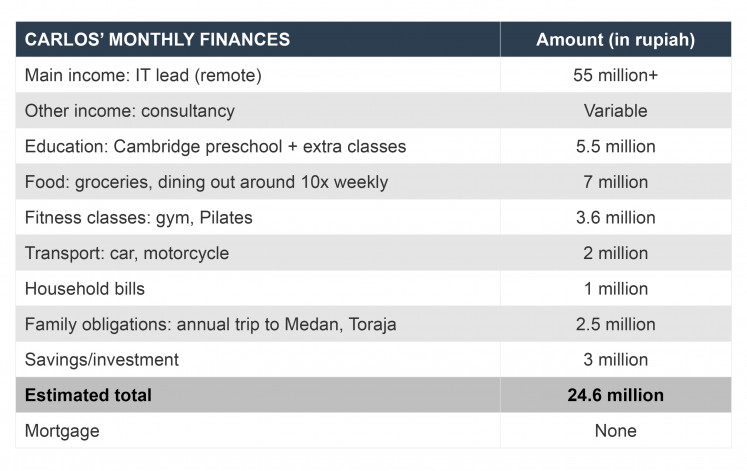
Carlos, 37, works full-time remotely as an IT lead while running his own IT consultancy on the side. He brings home Rp 55 million a month, not counting earnings from his side business. He is the sole earner; his wife manages their home and children.
"It is more than enough," he says. "We monitor our spending, but we're not too tight with money."
That leeway shows up most at mealtimes. The family eats out almost 10 times a week, driven partly by their active lifestyle: regular gym and Pilates classes that tend to end near cafes.
"I admit that our frequency of dining out is a little bit high, but it's not our priority right now to cut down [on that]," Carlos says.
Total spending on food, including groceries and dining out, runs to Rp 7 million a month. Fitness classes cost Rp 3.6 million. They own a car and motorcycle, which racks up Rp 2 million on fuel and maintenance.
Other fixed costs include Rp 1 million on household bills and Rp 2.5 million set aside for family obligations. Carlos’ hometown is in Medan, North Sumatra, while his wife's family is in Toraja, South Sulawesi. Every year they visit both, making annual flight costs a fixed savings target. When time and money allow, they travel to Bandung, Bogor or Puncak, or opt for a staycation in the city.
Since their mortgage is already paid off, their monthly spending totals around Rp 22 million.
Out of all their expenses, it's the education line that Carlos is most deliberate, and most proud, about. His daughter is just two and a half and already takes weekly ballet and music classes while attending a Cambridge preschool.
"It was clear from early on that she is ahead of her peers. Even her teacher told us she can attend preschool already," he says.
He's still working out which instrument she loves most, but for now, the music class is about exploration. The plan is for her to pursue the Cambridge track all the way through senior high school.
With his income, Carlos can give his daughter the education he wants for her and still set aside Rp 3 million a month in savings or investment.
A second child, though, would mean making some changes. "We'd have to totally rethink our expenditure," he laughs.
Anton: Spending within his means
With a dollar-based income and no obligation to care for his parents or in-laws, Anton could spend more but chooses not to, and his children's education is still the largest budget item.
Growing up in Lampung, Anton, 39, never quite absorbed Jakarta's materialistic bent. For him and his family of four, a good evening is watching YouTube or Netflix together on the living room screen. This isn't a lifestyle of restraint, he's careful to clarify, but a lifestyle he believes is best for his relationships with his wife and two children.
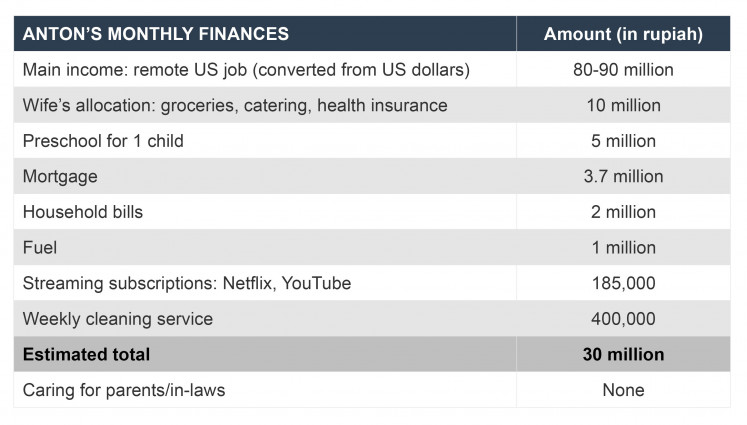
Anton studied and worked as a graphic designer for several years in the United States, and he was fortunate to keep his remote position after returning to Jakarta. This means he earns in US dollars and converts only what his family needs into rupiah, bringing home Rp 80-90 million a month.
He transfers around Rp 10 million to his wife for monthly groceries, daily catering and health insurance. Anton manages larger expenses and leisure separately.
With a 4-year-old and a newborn, both Anton and his wife are committed to hands-on parenting without a nanny. Since they're both mostly at home, they split the housework evenly: dishes, laundry, bathing the children. A cleaner from a home services app comes once a week to their apartment in North Jakarta.
Their monthly spending runs to around Rp 30 million. The largest item is their older child's preschool at roughly Rp 5 million a month, followed by mortgage payments at Rp 3.7 million. Their household allocation covers groceries and catering up to Rp 2.5 million, while the monthly bills come to Rp 2 million. Anton also has a small espresso machine at home, a meaningful saving for an avid coffee drinker.
Since they rarely leave the house, they spend only around Rp 1 million per month on fuel. The Netflix and YouTube subscriptions total Rp 185,000. Many of the children's toys are gifts, while the newborn is wearing hand-me-downs from her sibling. On weekends, they visit nearby malls, go to Japanese restaurants or take the eldest to a children's park.
Even with an income he describes as "more than sufficient”, Anton rarely spends beyond what he needs, and he uses his credit card like a debit card.
"If we go out at midday on a Saturday and spend Rp 500,000, we usually choose to stay home that night," he says.
When they travel abroad, he favors casual strolls, regular coffee shops and local restaurants over tourist attractions. They've managed one international trip a year, the last two to Japan.
Neither Anton nor his wife receives financial support from their parents but they're not in the sandwich generation either, so their bottom line isn’t pulled by allowances for their parents. That gives them significant room to invest more in their children's education.
That said, they aren’t necessarily aiming for international schools. Since these schools tend to attract privileged families, he explains, "sometimes, the teachers are intimidated by the parents”.
Anton would rather find like-minded parents, particularly those who are directly involved in raising their children. "Children grow up so fast. It's important that parents are hands-on in taking care of them."
Their financial goal for their children is independence, not provision.
"We want them to pursue scholarships, work part-time, go abroad," Anton says. "But we also wish that they won't need to take care of us when we're old, so our goal is to have enough savings when we're elderly."
Bayu: Saving for overseas schooling
At his income level, the question is not whether to invest in education but how far to go. And for Bayu’s children, the answer might be Singapore.
Bayu has always been motivated by the satisfaction of building things. He spent 13 years working at tech companies in Malaysia, Singapore and Jakarta while building his side business.
His wife is even more driven, he says with clear admiration. "She is more of a workaholic than me, usually working until 3 a.m."
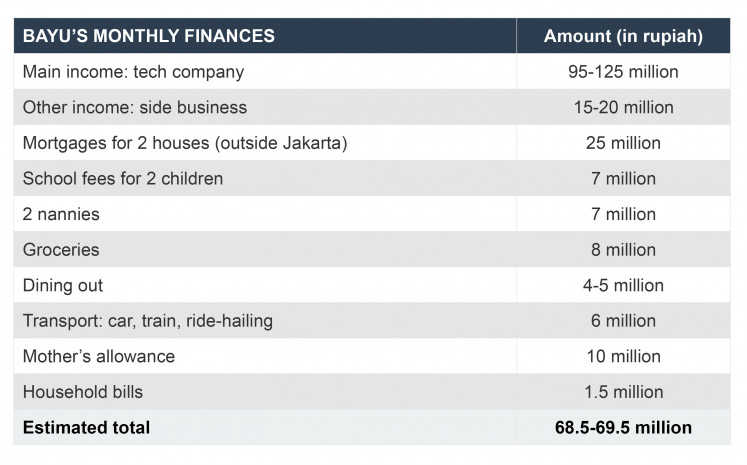
Bayu, 34, earns Rp 95-125 million a month at a top tech company, with an additional Rp 15-20 million from his side business. His monthly spending is Rp 68-70 million, with the largest share going to mortgages on two houses outside Jakarta.
He commutes from Bintaro in South Tangerang to Jakarta by car, train or ride-hailing depending on the day, for a combined monthly cost of Rp 6 million. Groceries run Rp 8 million, dining out with the family costs Rp 4-5 million and household bills total Rp 1.5 million.
He sends Rp 10 million a month to his mother. School fees for his two children, aged 6 and 4, come to Rp 7 million and two nannies cost another Rp 7 million.
Until recently, Bayu and his wife split everything evenly. When she launched her own business a few months after their second child was born, they shifted to largely separate finances, a structure deliberately designed to keep her motivated and autonomous.
"She loves working. Keeping our earnings separate is [a mutual] way to drive her so she can grow her business," he says. "But of course if she needs anything, I'll buy it for her."
Despite an income level that places his family well above the middle class, Bayu sees Jakarta’s cost structure clearly.
"Jakarta's cost of basic necessities is the same as developed countries like Malaysia or Singapore," he says. For a family of four to live comfortably, he puts the figure at Rp 50 million a month.
He also has started saving for his children's education already, including the possibility of university abroad and attendant costs, which he estimates will run into the billions. Both children are currently in a supplemental learning program that uses Japan’s Kumon self-study method, and Bayu hopes to add language and sports tutors.
"If I have significantly more income, I'm hoping to send them to Singapore for junior and senior high school," he says, revealing his most ambitious goal.
Regarding hard assets, Bayu thinks his generation has different goals from that of his parents.
"It’s very stupid to buy things nowadays,” he says. “Do not restrict yourselves to hard assets like cars and properties. If your goal is wealth optimization, [save] as much cash as possible."
Though he concedes that he owns two houses, he attributes this more to luck than strategy.
The question of schools
Four families, four philosophies, one city.
Alya's children are in a private national school focusing on character building. Carlos is already charting a Cambridge track for a toddler who doesn’t yet know which music instrument she likes.
Anton is looking for schools where teachers aren't intimidated by the families they serve and has parents with a similar mindset. Bayu is saving billions of rupiah for his children’s future education, possibly in another country.
Combined, what their differing approaches reveal is the particular pressure Jakarta places on parents: the sense that the decisions parents make before their child understands what “decision” means will shape the entire arc of their life. That fear, more than tuition, grocery bills or mortgages, is what makes raising children in the city feel expensive in ways that don't show up on any spreadsheet.
What every family here shares, regardless of income, is doing the math and then doing it again. The numbers change, but the question stays the same: Is this enough?
Michelle Anindya is a writer and journalist. From her home in Bali, she writes about anything from coffee to tech.