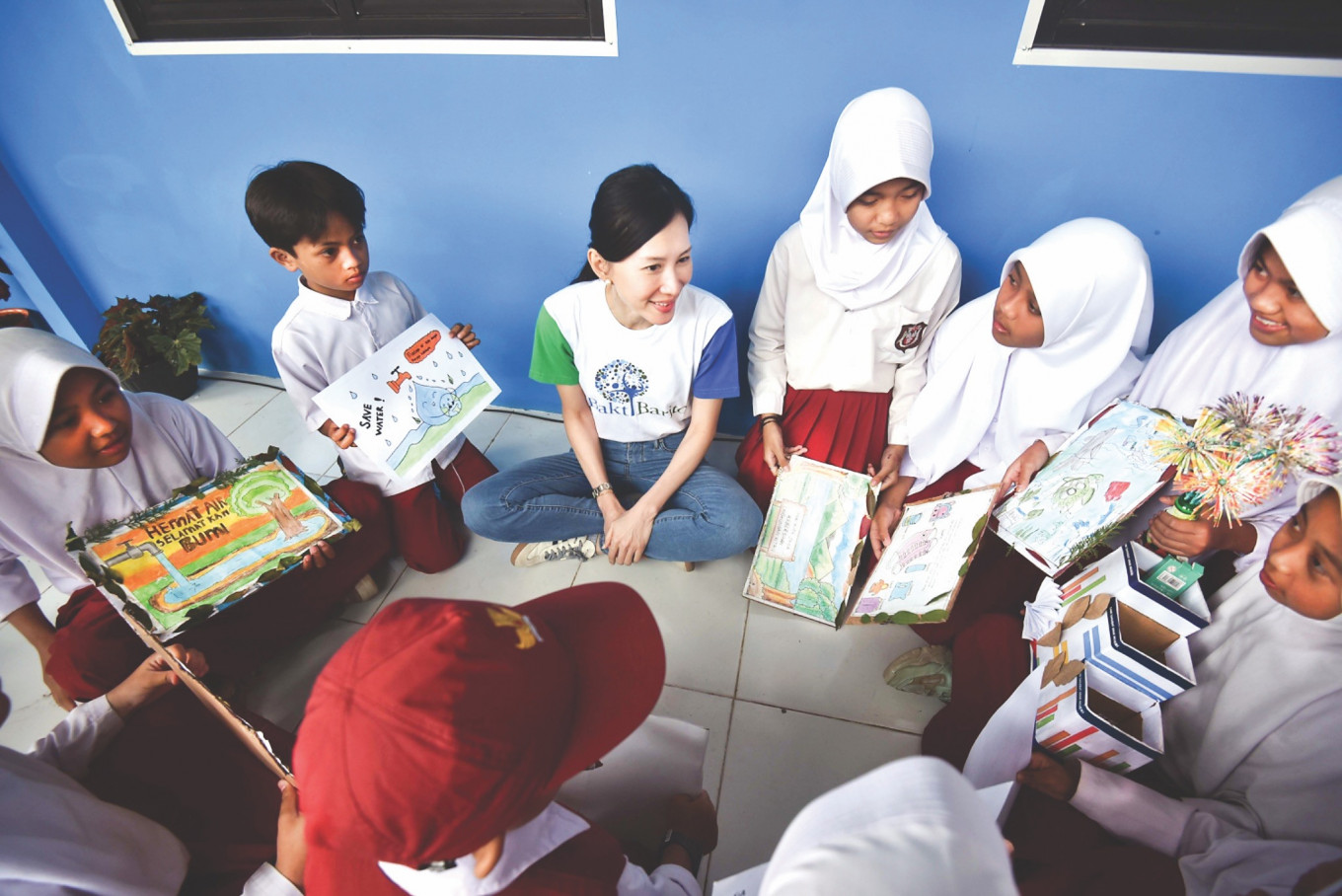
Fifi Pangestu (third left, top), executive director of Bakti Barito Foundation, visits SDN 4 Barusari elementary school in Garut regency, West Java, during a ceremony to mark its reopening in 2024. (Photos Courtesy of Yayasan Bakti Barito)
As the story goes, a public school located in Mekarsari, Garut regency, West Java, was dealing with an overwhelming amount of plastic waste. To counter and mitigate the problem, principal Yuyu Yohanah Rahmat came up with a plan to change the school’s culture.
He added more garbage cans around the school and started a movement to encourage students to bring their own reusable containers, called the Membawa Bekal Wadah (MEWAH) program. The result was an immediate reduction in waste.
This shift in culture, though initiated by one person, will work only when the community as a whole supports it, creating a chain reaction that leads to growing benefits. And when it comes to environmental causes, Indonesia is in need of change.
The government’s policy to include environmental education in the national curriculum was first outlined in the 1984 curriculum. The policy was further supported by the Adiwiyata School Program, launched in 2006 by what was then the Environment and Forestry Ministry, which encourages students and educators to lead with environmental awareness and responsibility.
To support this initiative, the Green Guardians program of Bakti Barito Foundation provides schools with teacher training, basic infrastructure support and the curricular guidance necessary to meet national environmental standards, giving them the tools to obtain Adiwiyata certification. Moreover, Bakti Barito Foundation also supports climate education as one of its core missions.
Yuyu Yohanah Rahmat is one of the many teachers taking the lead in climate action across the country, and “perfectly captures the essence of the Green Guardians program”, said Fifi Pangestu, executive director of Bakti Barito Foundation.

Thank you!
For signing up to our newsletter.
Please check your email for your newsletter subscription.
He is living proof that, in most cases, a small change in habit can lead to a massive impact.
Finding a cornerstone
Founded in 2011, the Bakti Barito Foundation started as an emergency relief effort for volcanic eruptions and floods. However, it quickly became a platform for the subsidiaries and affiliates of parent company Barito Pacific Group to implement social and environmental responsibilities in the communities where they operate.
“Our contributions are not just charitable giving but part of an effort to create systemic change. In every moment of growth, one thing remains constant: the power of human connection. Whether it's seeing scholarship recipients graduate from college, witnessing communities recover from disasters, or hearing stories of young people finding meaning in their professions, these moments remind us of the core reason we do what we do. This is the spirit that keeps our mission alive,” said Harlina Tjandinegara, chairperson and founder of Bakti Barito Foundation, as quoted in its latest annual report.
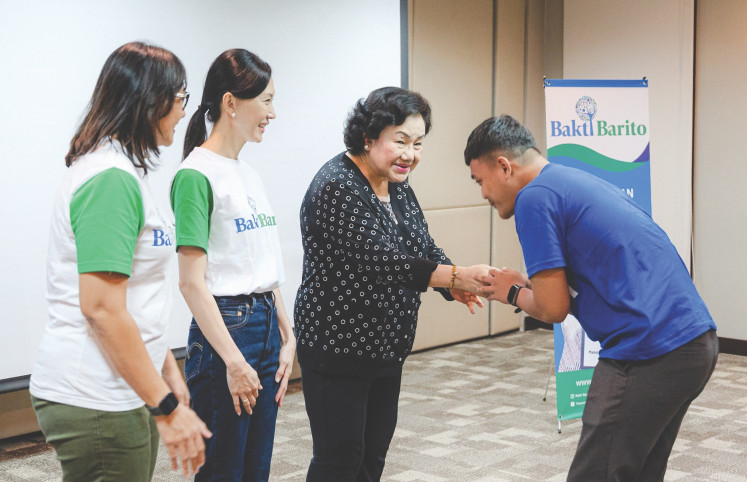 Harlina Tjandinegara (second right), chairperson and founder of Bakti Barito Foundation, attends the Bakti Barito Scholarship Ceremony 2025 on 9 July 2025 in Wisma Barito Pasific I. (Photos Courtesy of Yayasan Bakti Barito)
The foundation’s mission is clear: to create long-term impact instead of providing one-off financial contributions.
“We set up Bakti Barito as a philanthropic vehicle that could use the company’s resources responsibly but act with a longer time horizon than typical CSR [corporate social responsibility],” said Fifi, who took over as executive director in 2017.
“For me it wasn’t a sudden decision, it felt like a natural progression from the family’s long-standing involvement in business and the communities around our operational areas. My in-laws started giving in ways that were immediate and kind, but as we grew, we realized that giving can be so much more than a one-off contribution,” she said, referring to Bakto Pacific Group founder Prajogo Pangestu and his wife Harlina.
Today, the foundation has made a name for itself as well as fostered collaborations with like-minded organizations. Bakti Barito Foundation received the 2024 Outstanding Partner Award for its support in helping local schools achieve the Adiwiyata Award from the Garut administration and the regency’s environment agency.
Meanwhile, Barito Pacific Group was recognized with the Appreciated Environmental ESG Report Award for its strong environmental initiatives, including its circular economy program through Chandra Asri Group and the Bakti Barito Foundation, climate education at elementary schools and support for Indonesia's net-zero target through Barito Renewable Energy (BREN).
“The foundation benefits from the group’s strengths: the technical expertise, the long-term presence and the commitment to doing things the right way. At the same time, the foundation has the freedom to look at issues systemically, whether it’s education, the environment or economic empowerment, and ask how we can contribute beyond day-to-day CSR,” Fifi said.
One of the biggest impacts has been through the Green Guardians program, which has given Bakti Barito the opportunity to collaborate with educators like Yuyu.
Green Guardians
“A big part of our Green Guardians program is about behavioral change and building awareness, like recycling waste, energy conservation and biodiversity conservation. Because behavioral change needs to be measured, not assumed, we’ve developed two monitoring tools alongside the University of Indonesia’s sociology department to evaluate the effectiveness of the national Adiwiyata program,” Fifi explained.
A collaborative study with the University of Indonesia found that schools with support from Bakti Barito excelled in community-based initiatives, particularly in waste management and tree planting. In comparison, non-Adiwiyata schools with environmental programs showed progress, but limited resources and lack of structured support hindered sustained behavioral change.
Jo Kumala Dewi, a former director of the Center for Environmental Generation Development (PPGLH) at the Environment Ministry, said: “Instilling environmental awareness from an early age is crucial for a sustainable future. With these measurement tools, we can see whether our environmental education is effective and use the findings to guide future decision-making.”
Fifi added: “We see ourselves as a catalyst. Our role is to strengthen what communities already have, identify their local champions and equip them with the tools and confidence to keep going long after we phase out. We don’t create parallel systems; we try to activate the leverage points within the existing one, including working closely with local administrations.”
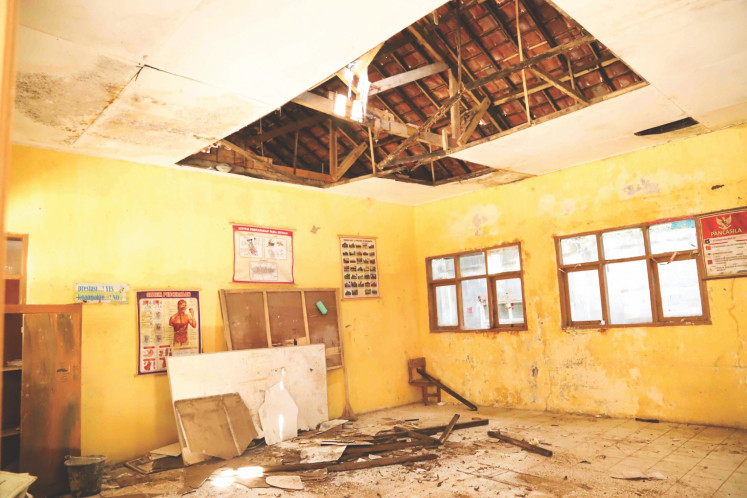 A collapsed ceiling (left) and the same classroom rebuilt with plastic bricks appear in this photomontage of SDN 4 Barusari elementary school in Garut, West Java. (Photos Courtesy of Yayasan Bakti Barito)
Around 60 percent of the work was a social process to connect schools with local communities and institutions to create smoother synergy for them to work together, while the complementary technical part made up the remaining 40 percent.
Fifi attributed this depth of engagement to an aim to create a more sustainable outcome, toward the main goal to ensure that communities and local administrations could carry the work forward and achieve a long-term impact.
Measure of success
“For me, lasting impact means that the communities we support have the capacity and resources to continue progressing, even after our specific programs have concluded. My husband often tells me that we want to teach communities how to fish, not just hand out fish,” Fifi said, referring to Bakti Pacific president director Agus Salim Pangestu.
“However, measuring this success can be challenging because the immediate results are not always visible. True success is about fundamental, long-term changes in society that take time to manifest,” she underlined.
Fifi admitted it was important to demonstrate the foundation’s impact and translate this into tangible outcomes. For the Green Guardians program, Bakti Barito measured its real value with a social return on investment (SROI) of 3.97, almost four times the social value for each dollar invested.
According to a press release from the Environment Ministry, the number of schools that received the Adiwiyata Award increased from just 10 in 2007 to around 28,000 in 34 provinces by the end of 2023.
“We operate Green Guardians with a one-to-one matching scheme with the Environment Ministry. In other words, for every school the foundation supports, we encourage local administrations to match that support, creating shared ownership, faster scalability and a clearer path to sustainability,” explained Fifi.
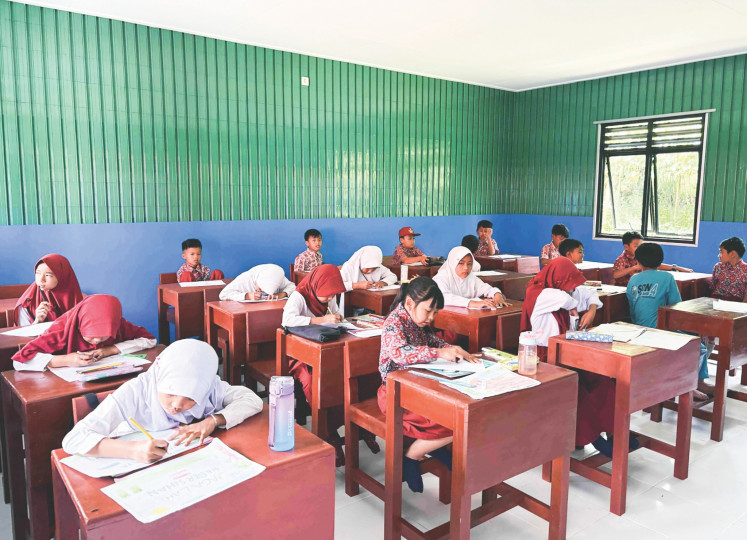 (Photos Courtesy of Yayasan Bakti Barito)
As of 2021, Bakti Barito has expanded its support to 121 schools, trained 12,600 teachers and reached over 34,000 students in Garut regency.
As the foundation revealed in its 2024 Annual Report, teacher training became a top priority in response to a 2021 UNESCO finding that less than 40 percent of educators lacked confidence in teaching climate-related topics. To address this gap, the foundation launched the Green Guardians Learning Series, which focuses on building teacher capacity. In its first year, the program engaged over 1,069 teachers, who were equipped with tools and strategies to effectively integrate environmental education into the curriculum.
Fifi also highlighted collaboration with other national organizations as an essential component, adding that Bakti Barito was interested in fostering more partnerships that share risk and scale proven solutions through government systems. Staying close to the reason behind its first introduction, the foundation recently contributed to disaster relief efforts in Garut.
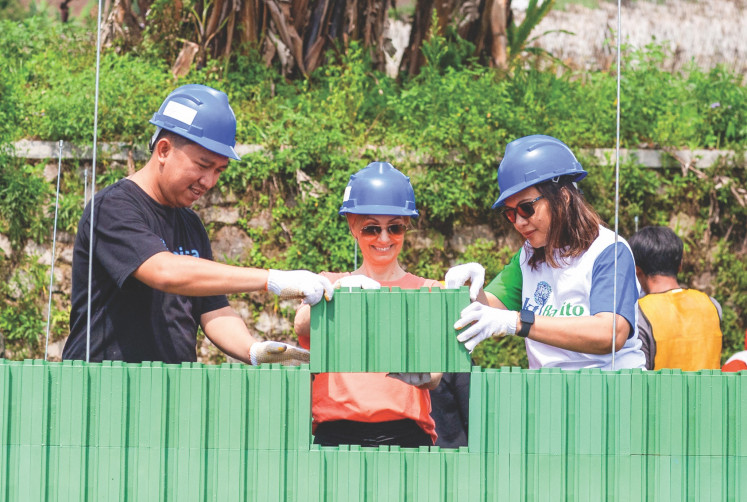 Edo Irfandi (left), director of online donation platform Kitabisa.org, works with Sylvia Beiwinkler (center), CEO of Happy Hearts Indonesia, and Dian A. Purbasari, director of Bakti Barito Foundation, to install a plastic brick during a school rebuilding program for SDN 3 Barusari elementary school in Garut, West Java. (Photos Courtesy of Yayasan Bakti Barito)
“Our collaboration with Kitabisa and Happy Hearts Indonesia successfully raised Rp 1.7 billion [US$101,500] to rebuild two schools completely destroyed by the earthquake in Garut. The newly rebuilt schools were constructed with earthquake-resilient materials, including approximately 9.4 tonnes of recycled plastic bricks, which reduced an estimated 22 tonnes of carbon emissions,” she said.
Looking ahead, the foundation hopes to see communities resilient to climate shocks, children learning in safe and green schools and a philanthropic ecosystem in Indonesia that is collaborative and impactful.
“There aren’t many players working in climate education but it’s incredibly important, especially for the younger generation. They are the ones who will live through a very different climate reality, and they will need a different mindset, a different mental model and a different set of behaviors and skills to adapt,” said Fifi.
“If we want them to thrive in a climate-impacted future, we have to start building that foundation now.”
This feature was produced in collaboration with Yayasan Bakti Barito.