(Shutterstock)
It was a Sunday morning in early October when I first heard "Alamak" by Rizky Febian and Adrian Khalif, a song about falling head over heels in love. I texted Belanegara Abe, the song's cowriter and music producer, to applaud him for his work.
The warm and cheery R&B tune felt fresh and jubilant, a welcome break from last year’s stream of tear-inducing ballads. The surge in heartbreak anthems had started to feel more exhausting than cathartic.
I was like, "We get it: Love sucks, this world sucks and life sucks. Should I not leave my house ever again?"
By Tuesday evening, something I thought improbable had occurred: "Alamak" blew past those heartrending tracks to reach No. 1 on Spotify's Top 50 Indonesia chart.
I texted Abe again to say congratulations, all the while asking myself: "Wait, do my fellow Indonesians actually share my exhaustion? Are we all tired of being sad now?"
What happened in the months that followed has answered that question.

Thank you!
For signing up to our newsletter.
Please check your email for your newsletter subscription.
Get happy
Hindia, who is not exactly known for being a romantic crooner, scored one of the biggest hits of his career in the final quarter of 2025 with the sudden rise of "Everything U Are", an ode to love as a saving grace.
In the pop realm, audiences embraced Nadhif Basalamah as he leaned into love despite life's fleetingness in his megahit, "Bergema Sampai Selamanya" (Echoing forever).
And very recently, Indonesians were collectively swept up by Idgitaf's chart-topping "Sedia Aku Sebelum Hujan" (I'll be ready before it rains), reminding listeners that love is still worth believing in.
As listeners gravitate toward these brighter tracks, more and more artists are moving away from writing sad love songs.
 (Juni Records)
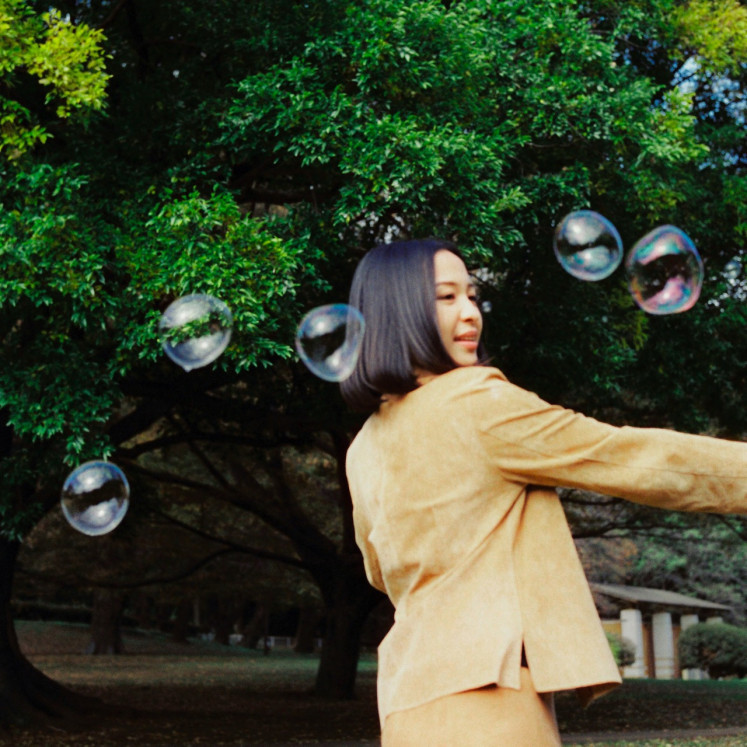
Bernadya kicked off a new era with her luminous "Kita Buat Menyenangkan" (Let’s make it good), about holding on to what's good in a relationship before it slips away.
Even Mario G. Klau, best known for his tearjerkers, recently leaned more into the glory of love with "Salah Kaprah #Anjay" (Minor blunder #Anjay).
Happy days again
I kept coming back to "Alamak", which seemed to have opened the door to this wave of joy, so reached out to Abe for a proper conversation about the song and its unexpected impact.
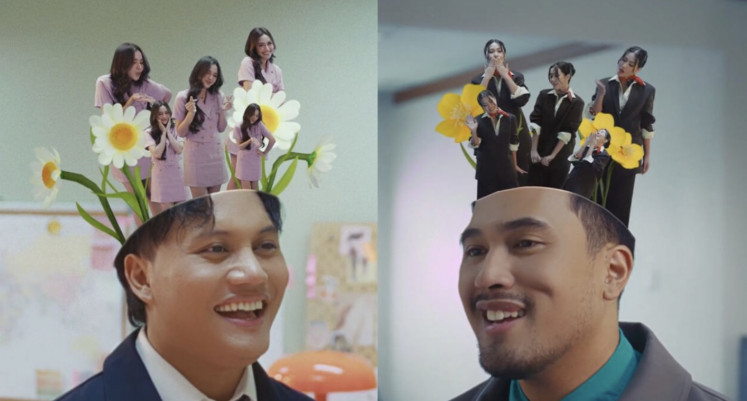
Even months after the release of "Alamak", which Abe describes simply as a "singable, feel-good song", the songwriter-producer is still intrigued by whether the prevailing mood helped propel it to success.
"This is actually the most interesting question," he laughs. "The audience's mood might play a part, but we [as songwriters] are more focused on the shape of the work."
 (E-Motion Entertainment)
Abe is modest when assessing the song’s impact, and sees this wave of joy as part of a broader "phase of musical development" in the industry, not a trend driven by just one track.
But it remains difficult to pinpoint what would resonate in today's fast-moving music landscape.
"For now, as I see it, it's still too soon to draw any conclusion," Abe says.
"As someone who writes songs in various [emotional] contexts and genres, I must always be ready to make that switch at any time."
Pursuing happiness
After talking to Abe, I reached out to Indonesia's most consistent feel-good hitmaker: Dipha Barus, a songwriter, music producer and DJ who has long understood the pull of uplifting songs.
He was recently the arranger and producer for Rossa's new extended play Asmara Dansa (Dance of love), which sonically spotlights the diva's euphoric side over her usual emotive vulnerability.
Dipha describes the EP as a "celebration of love, but on a dance floor".
"The state of falling in love should also be romanticized," he says. "People have forgotten that the joy and hopefulness of love can also be turned into a love song."
Pondering the audience response to happy songs like Idgitaf's "Sedia Aku Sebelum Hujan", Dipha suggests that Indonesians might be growing tired of "celebrating heartbreak", a mood that defined the music scene during the COVID-19 pandemic.
"I think the post-pandemic emotional reset is playing a huge part in this," he says.
"All [Indonesian] music audiences are now thirsty for that energy, the feeling of love that is more uplifting and tuneful."
Making it fun
But is it the audience's mood that prompted this wave of happy love songs, or did the songs lead the way?
Dipha believes it’s the former. "I think people are tired of waking up in the morning, looking at social media and finding out that this world is still such a mess," he says.
"People are looking for something like a utopia, a more hopeful world. And that utopia exists in the songs they choose to listen to."
Indonesian musicians and audiences alike might finally be in the mood for a love song that resembles a warm Sunday morning. Many of these happy love tunes sit in the mid-tempo range, not necessarily the kind that makes you jump off your feet.
Even so, drawing on the crossover impact of his and Nadin Amizah's bouncy "All Good" back in 2017, Dipha believes that one day Indonesians will be ready to party again.
"It's possible to feel good. It's possible to enjoy a song that makes us happy and feel good. It's just a matter of time," he says.
So, maybe this isn’t a mere trend but a kind of emotional healing. After years of mired in heartbreak, listeners might be ready for the good stuff, ready to hold on to something lighter and ready to make love fun again.
Bernadya's "Kita Buat Menyenangkan" taught me that.
And if music has always been a mirror, then right now it’s suggesting something we haven't seen in a while: a simple, stubborn hope that love is still worth the trouble.
For now, that might be enough.
Felix Martua is a music and film journalist who has interviewed countless artists over the years. He’s known for his signature black jacket, Ghibli collar pin and slightly sinister grin.