(B/NDL Studios/Budhi Button)
Who here would agree that 2025 was not an easy year? How many of us cried quietly in our own rooms, wondering how a year that began with hope slowly turned into something heavier?
We moved through the months carrying silent battles we didn’t always share. Battles that forced us to slow down, sit still and question many of the things we thought we knew about life.
For me, 2025 was a year that required endurance rather than excitement. The world didn’t feel gentle. It felt demanding and unpredictable, as if I was being asked to process more than I had the capacity for. It wasn’t a rainbow-and-cupcakes kind of year.
It was a year of staying afloat, of holding myself together, of quietly hoping that something inside me was strong enough to remain steady.
A fresh start
Like many people, I began 2025 with the familiar belief that a new calendar means a new life. A fresh start. Everyone around me was setting goals, building routines, planning habits, learning new skills.
Thank you!
For signing up to our newsletter.
Please check your email for your newsletter subscription.
There was an unspoken pressure to upgrade yourself the moment January 1st arrived. So I joined in.
With full new year enthusiasm, I signed up for private tennis classes, imagining myself playing gracefully in cute tennis outfits. I enrolled in private French lessons, secretly hoping I could become a little smarter and prettier à la Emily in Paris. I even impulsively bought a Kindle and promised myself that this would finally be the year I became someone who reads more books.
I moved through the first months of the year like a ship sailing confidently but without a proper anchor. I was trusting momentum more than preparation. From the outside, everything looked fine.
Inside, however, I was not stable at all. By the time the year reached its second quarter, everything on my list had quietly stopped.
Life, interrupted
The work grew heavier, the weight of responsibility kept increasing. On top of that, unexpected family issues suddenly emerged and demanded immediate attention. Before I had the chance to process one emotion, another problem was already waiting.
The waves of life came relentlessly, crashing again and again, leaving me unsteady, without anything firm to hold onto. And so, I drifted.
Then came the losses. I lost my best friend. I lost my romantic partner of three years. I also lost my beloved dog.
Those are the kind of losses that arrive from different directions at once, leaving me no room to breathe. They forced me to understand very abruptly that life is much bigger than any plan I carefully arrange at the beginning of the year.
In the middle of that storm, I had forgotten what it felt like to grow. I was busy surviving, processing and fixing life.
Resolutions forgotten
I stopped going to tennis classes and quit my French lessons. I no longer had the space or the energy to develop myself. Simply not falling apart already felt like something to be grateful for.
The resolutions I made at the beginning were supposed to be fuel, something that would carry me forward, helping me keep growing and evolving. But in those moments, they felt more like an extra burden, something I needed to discard quickly just to survive. Even so, I blamed myself for not being consistent, for being a total failure.
And you know what made it feel even worse? The fact that this was not the first time it had happened.
 (JP/Andersen)
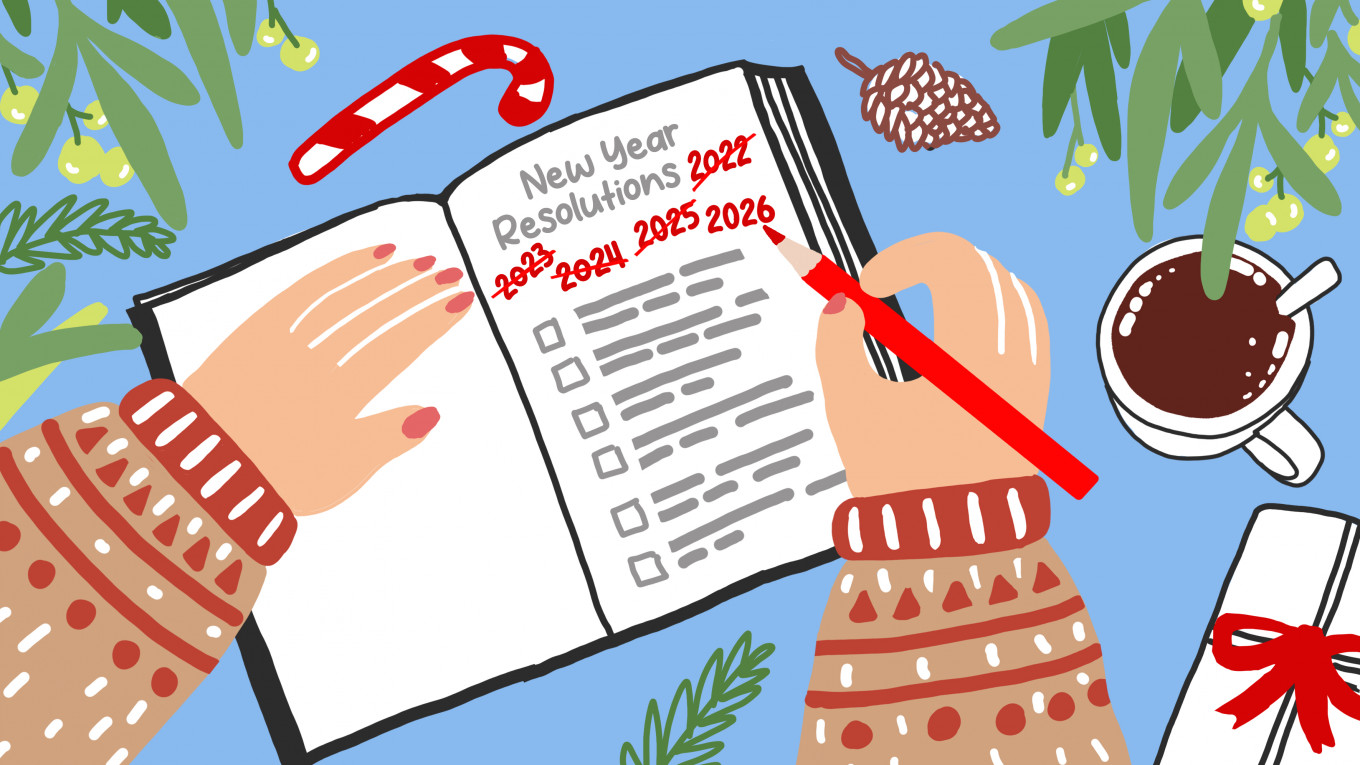
Every new year, I made a long checklist, only to watch it fall apart halfway through the year. 2025 was no different. Once again, I failed to carry my resolutions to the end of the year. I always stopped in the middle, hoping that next year would be different.
Sitting with this pattern longer led me to a different perspective. Maybe the problem was not that my resolutions were unrealistic, nor was it a lack of discipline. It was the stability I had within myself.
I kept asking myself to move forward without first making sure I was firmly anchored. I kept trying to perform without building the capacity to live through interruptions. So every time life did what life does, I fell apart.
Amor fati
In the middle of that heaviness, I came across a branch of philosophy known as Stoicism. It teaches that life comes as a full package. There is no choosing, no cherry-picking only the pleasant parts. Joy exists alongside grief. Comfort alongside chaos. Victory alongside heartbreak. Peace alongside disruption. These opposing forces are the structure of human life.
The part of Stoicism that changed me the most was a concept called amor fati, a Latin phrase that means loving your fate. There is something tragically beautiful about that idea. Loving life without selecting only the parts we like. Loving what happens not because it feels good, but because it is part of being alive.
For a long time, I resented life for not being gentle, for never being kind enough in the moments when I needed it most. Life always seemed to have its own way of ruining the plans I carefully built with hope and belief. I carried my anger quietly, asking myself again and again why it had to be me and why it had to happen now.
Every first day of the year, I tried to begin a new life with new hope, convincing myself that starting over was still possible. Yet somewhere in the middle of the year, life always found its way back in, undoing everything I had slowly put together, reminding me that not every plan is meant to survive until the end.
Embracing life as it is
Stoicism, and amor fati in particular, shifted the way I understood these moments. My resolutions were not wrong. My hopes were not naïve. What was fragile was the foundation beneath them. I was building goals without first building the capacity to carry them when life became difficult.
Amor fati does not ask us to celebrate pain or glorify suffering. It asks us to stop fighting reality, because resisting what is already happening only multiplies suffering. It invites us to stand inside life as it is, instead of exhausting ourselves wishing it were something else. A willingness to endure the storm without blaming ourselves for the weather.
All the hardships I experienced, the losses, the heartbreak, the plans that fell apart, were not personal punishments or signs that I had done life wrong. They were simply life doing what life has always done.
Living, by its very nature, carries struggle, loss, and disruption.
Nietzsche wrote that “to live is to struggle” because struggle is not a mistake in life. It is the consequence of being alive, and there is nothing abnormal or tragic about that.
I was not really starting over each year. I was delaying something harder.
By focusing on new goals and fresh resolutions, I avoided facing the fact that no amount of planning could make life predictable. It felt safer to believe in a new beginning than to accept that uncertainty would always be part of living.
The missing anchor
With that understanding, entering 2026 feels like the moment to pause from making resolutions that are performative and overly focused on visible achievements.
This time, I want to learn more about life principles. Principles that may not always sound beautiful, but are strong enough to anchor me when life moves in directions I never planned, including the willingness to accept life as it is and as it comes, not only in its pleasant forms.
I want to learn that life will always be difficult in its own way, and that difficulty is not a deviation but part of the path itself. Blaming life for the failure of the goals I set at the beginning of each year now feels unwise and more like avoidance of life.
Looking back, the goals I set at the beginning of 2025 did not fail because they were unattainable or because life was cruel. They failed because I was not anchored. I did not yet understand how to live in a world designed to arrive with constant friction and struggle.
A ship can move fast and far, but without an anchor, it will drift when the sea changes. That was me. When the storms came, I fell apart, and everything I had planned crumbled apart with me.
I have come to believe that when we understand how to live, goals do not simply collapse the moment life becomes difficult. We can still have intentions, plans, and hopes for growth, but we no longer break down when reality does not follow the script we wrote at the beginning of the year.
Maybe the real resolution is this
So maybe the question at the beginning of a new year is not what kind of resolutions we should make, but whether we are actually ready to live the life that comes with them.
If we choose once again to create performative resolutions, can we honestly commit to them without being disrupted by life itself, or are we simply repeating a familiar cycle, mistaking intention for readiness?
And if the answer is no, then perhaps what needs attention first is not another list of goals, but the anchor. The inner stability that allows us to remain present when life becomes heavy, unpredictable, and inconvenient.
For this year, I am choosing to pause from adding more goals. I am choosing to deepen my understanding of amor fati, learning how to accept life as it is and as it comes, not only when it aligns with my plans, but also when it interrupts them.
So before deciding where else we want to go, maybe the more honest question is this: Are we ready to commit to our resolutions without being undone by life, or do we need to learn how to stand steady first?
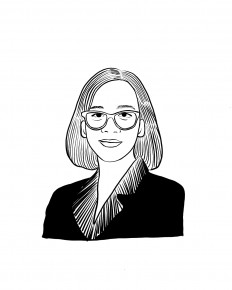
Tia Monica Sihotang works in the law field and often finds herself drawn to questions about gender, children and everything that sits quietly in between.