(Shutterstock)
There are now more rules to texting someone than filing taxes.
Don’t reply too fast. Don’t double-text. Don’t come across as clingy. Give it time. Let them wonder. Maintain some distance.
No one officially teaches these rules. They come from TikTok videos, Instagram posts and late-night conversations with friends who are trying to figure things out just like we are. Somewhere between the scrolling and the swiping, romance acquired its own unofficial handbook: the three-month rule, the no-double-text rule, the don’t-be-clingy rule.
And along the way, something that used to feel so simple started to feel like trying to pull off a perfect Queen’s Gambit in a game of chess. Maybe even more complicated than solving Senopati’s parking problems.
At what point did relationships stop feeling intuitive and become a game of strategies we have to master?
Social media as the architect
Thank you!
For signing up to our newsletter.
Please check your email for your newsletter subscription.
To me, the rules feel familiar because I’ve absorbed them without even realizing it. They don’t manifest in any obvious way, but through the things I see and hear every day. Because of that unofficial handbook, I’ve caught myself pausing before sending a message, rereading it, adjusting the tone so it doesn’t come across as “too much”.
The strangest part is that it doesn’t feel like I’m following rules. It feels natural, like this is simply how dating works now.
Maybe that’s because of where those instincts are shaped. Social media, and more specifically the algorithm behind it, doesn’t just show us content; it reinforces certain behaviors. The things we linger on, the videos we watch a little longer, the posts we engage with, they come back, slightly repackaged, carrying the same ideas in slightly different forms.
This is a form of observational learning, explains Ermanda Saskia Siregar, a lecturer at the Faculty of Psychology at Universitas Indonesia, which means “people begin to adopt behaviors simply by seeing them repeated often enough”.
When those patterns repeat consistently, they stop feeling like advice and start to feel like common sense.
That’s how it works. The algorithm doesn’t tell us what to do directly; it works its way into how we think. Until the line between what feels normal and what we’ve been taught to believe becomes harder to see.
When the algorithm enters the room
I remember meeting someone once at the smoking area of a club when I was in university. It felt almost cinematic, like a scene from a romantic comedy. Conversations flowed easily, carried by the smoke and some muffled music in the background. There was no effort to it, no second-guessing. It felt easy.
But then I got home. With his social media account on my phone and time to scroll, I was free to look him up, to replay the night with a different lens, to over-analyze what it all meant.
 (Shutterstock)
It was as if I was unconsciously looking for reassurance from the algorithm itself, searching for some foolproof formula that would tell me how not to mess it up.
The intention behind it was genuine. I liked him. But I didn’t trust myself enough to navigate those feelings on my own. That was how deeply the social media rules had already taken root in my mind.
That was exactly where things changed.
What felt simple in the moment started to feel like something that needed to be managed. Not because anything had changed between us, but because the interaction had entered a space where everything could be interpreted, reframed and evaluated.
Meanwhile, he may have been doing the exact same thing. And without either of us deciding to, the dynamic shifts. The interaction is no longer just between two people, but between two people and the invisible norms shaping us both.
We weren’t the only ones experiencing it either. When I interviewed people in their late teens and twenties about dating, the same patterns emerged: the pause before replying, the instinct to tone things down, the worry over how something might come across.
They didn’t do it because they wanted to play games. They did it because it felt safer.
Psychologist Satriyo Wibowo describes this as a shift toward a more performative way of living, where even private interactions begin to feel as if they exist before an audience. In that kind of environment, expression becomes more cautious, not because we are insincere, but because it's too risky to be vulnerable and we don’t want to be misunderstood.
Over time, that awareness doesn’t stay in the background. It becomes part of the relationship itself.
So what do we do now
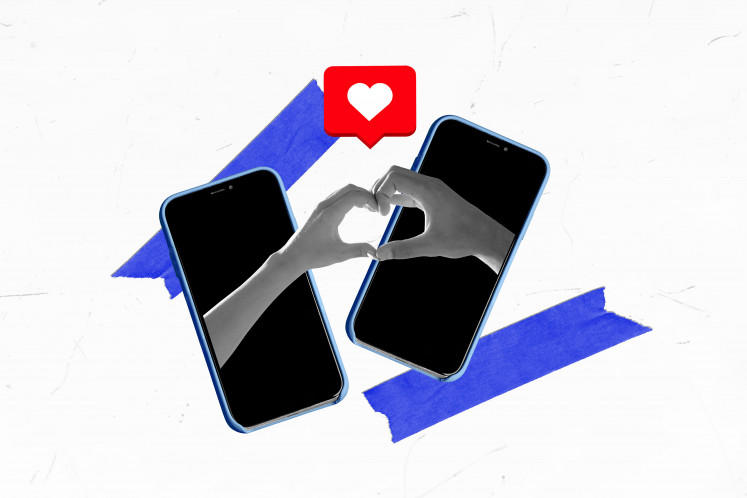
Of course, the algorithm isn’t the only reason behind this behavioral shift. It just reflected and amplified the fears people have developed over previous experiences.
 (Shutterstock)
As Arale Rayhan Subrata, a final-year psychology student at Universitas Katolik Atma Jaya Indonesia, puts it: “At this stage of life, people want closeness, but they’re also learning how to protect themselves from getting hurt.” That’s why we hold back even when the feeling is genuine.
Maybe that is why modern dating feels so exhausting. We want intimacy, but we hesitate when it asks something real from us.
So maybe the solution is not to pretend we can escape these unofficial rules entirely.
The algorithm is already here. It shapes what we see, how we think and, more often than we realize, how we respond. There is no returning to some untouched, perfectly organic version of dating.
But that doesn’t mean we have to let it do all the thinking for us.
If anything, the challenge now is staying human inside it. To filter more carefully. To notice when advice starts replacing instinct. To ask whether something actually feels true, or just familiar because we’ve seen it too many times. To stop treating every connection like a problem to solve or a game to win.
Still, there has to be a way of moving through this without losing ourselves in it.
Maybe it starts with choosing honesty over performance, and presence over strategy. Maybe it means letting a text be just a text, and letting interest be just an interest, before it is filtered into something else entirely. Maybe it’s remembering that not every feeling needs to be optimized before it is expressed.
Because if relationships are going to survive the algorithm, authenticity cannot become collateral damage.
We may not be able to stop the noise completely, but we can decide which voices deserve our trust and which ones were never ours to begin with.
Dedari Arane Wibowo is a Jakarta-based Gen Z writer and a professed hopeless romantic, fascinated by how digital culture shapes intimacy. When she’s not overthinking a text, she’s most likely writing about it.