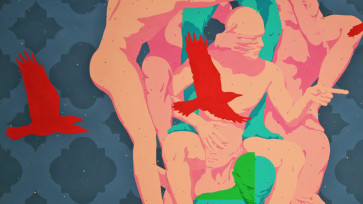
(B/NDL Studios/Budhi Button)
For us Gen Z, a generation that grew up online, posting on social media has always been the norm.
We document our lives down to the smallest details through posts, stories and reels. But increasingly, we don’t do it in public. We do privately, on our second Instagram accounts, where your “follow” request has to make the cut.
Once upon a time, we used social media to expand our social circles. That function now takes a backseat as we shrink into smaller circles.
And this shift is a response to how the internet feels today: overexposure, constant performative acts and the unease of being watched. In a world where digital footprints can turn on you at any time, privacy isn’t a given. It has become something you have to construct intentionally.
A space to be yourself
From conversations with those older than me, I learned that the concept of having multiple social media accounts isn’t new. Millennials had finstas (fake Instagram accounts), often anonymous, to snoop on other people.
Thank you!
For signing up to our newsletter.
Please check your email for your newsletter subscription.
But our second accounts today serve a different purpose. They’re not anonymous; they’re selective.
Think of them as private rooms where you choose who gets to enter, where you can post without calculating engagement or worrying about how you're perceived. For many, it's the only place online that feels most like yourself. The realest you.
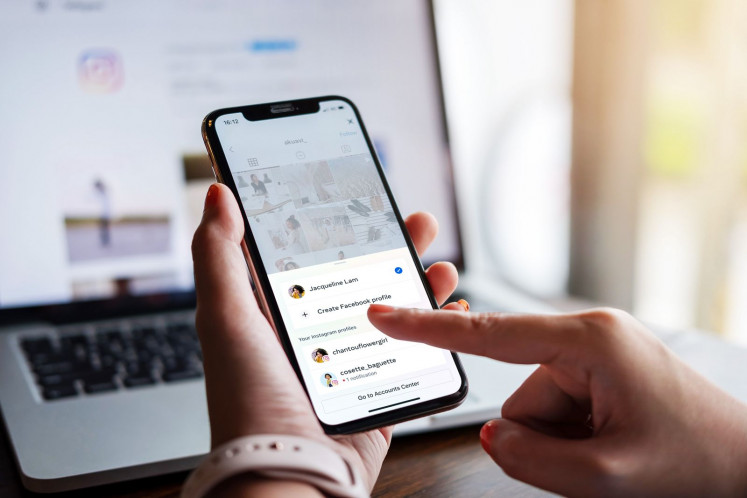
And ironically, my default Instagram profile is actually my second account.
My first account only has one post up, maybe a story uploaded once in a blue moon. My direct messages are nonexistent, with only a few short interactions between acquaintances.
 (Shutterstock)
Meanwhile, my second account is dense with daily conversations, replies and updated stories. A running log of what my life actually is.
Unlike with more public first accounts, there’s no pressure to perform. I don’t feel the need to post my milestones, feel-good content or polished versions of myself.
The same is true for Alda (not her real name), 22.
“I tend to use my second account like a digital junk drawer. I post everything in there: photo dumps, food pics, random snapshots of my life, from hobbies to what I’m currently doing, to random anime edits I saw on my timeline,” she tells me.
That looseness is the point. Second accounts allow people to be more authentic, to show even the most mundane or silly parts of themselves. For some, it’s one of the few places where they don’t need to hide.
For others, the stakes are higher than just aesthetics.
“My second account is only followed by close friends and people who know that I’m queer,” Liz (not her real name) said.
Alda, who is also queer, feels the same way. “I’m able to reveal and express my sexual orientation without the need to censor myself in fear of judgment or persecution in my private account.”
In a country where queer identity still carries real social risk, the second account isn't just a preference. It's a form of protection.
But access isn’t limited to close friends.
“The people in my second account are people I actively want to connect with. I want them to know what’s going on with my life,” Alda said.
“In reality, the people I let in my second account aren’t always people I’m close with. They are those I’ve come to trust with my real personality and won’t judge me for it.”
Trust, not proximity, becomes the filter.
Public profiles
There was a time when Instagram felt casual: blurry photos, poorly photoshopped edits of people with their favorite celebrities, captions written without much thought.
Now, first accounts have become carefully curated masks. A portfolio of sorts.
Audrey, 22, said, “My first account is used for when I want to occasionally show only a sliver of my most recent personality or activity, because I don’t want people to know that much about me.”
What changed?
Nowadays, instead of asking for someone’s number, we ask for their Instagram account. Our profile has become an introduction, a first impression, our social currency.
“It became a courtesy to share your socials with people. That means that sometimes I find myself following people that I barely have relationships with—acquaintances, old schoolmates, random strangers I met in public events—even though I don't actively desire to do so,” Alda said.
That visibility comes with trade-offs. A phone number reveals very little. An Instagram profile reveals just enough to feel exposed.
For people who value privacy, that exposure can feel daunting. But instead of withdrawing fully, they move to second accounts, where the audience is chosen.
Curated personas
For many of us, first accounts have become functional. They’re where you signal competence, ambition and productivity.
“I purposefully curate and sanitize my first account for strangers. I post my achievements and milestones like graduations, getting a new job, etc.” Alda said.
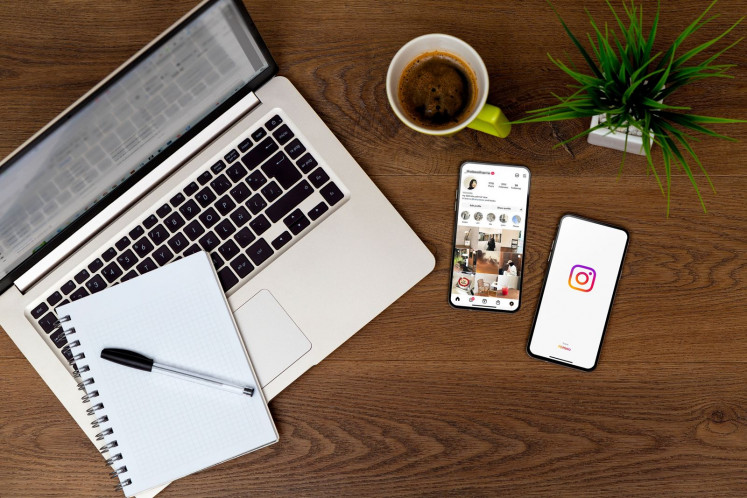
Liz uses her first account for personal branding, mainly posting framed pictures called twibbons, or uniform frames used for social media campaigns, usually related to academics and professional pursuits.
 (Shutterstock)
It’s common for prospective employers to ask for or independently look up your public profiles. Many of us have had to disclose our social media usernames in job applications and post twibbons just to be considered for an internship. Our social media persona has become another factor to manage while we build our careers.
Add strangers, coworkers and professional networks into the mix, and authenticity starts to feel risky. Our private space has narrowed.
But is this a bad thing?
Dunbar’s number, a concept proposed by anthropologist Robin Dunbar, suggests that humans can only cognitively maintain around 150 stable relationships.
How many followers do you have on your first account? Mine exceeded that number long ago.
We’re not built to be seen by hundreds of people every day. But online, we are.
Second accounts are our way of adjusting to the new digital social landscape, giving us space to be ourselves after a long day of keeping up appearances elsewhere.
Being fully authentic, all the time, is overrated. It’s not a character flaw to not open up to people we have no interest in being vulnerable with. If anything, having blurry boundaries with social media acquaintances isn’t healthy.
We don’t need to be everything, for everyone, everywhere. We can separate the clean-cut persona from the authentic self. We just need spaces where we don’t have to perform.
Second accounts aren’t about hiding. They’re about choosing where we can take off our masks. And in that sense, using a second account means actually using social media as it was first intended: to strengthen connections that matter.
Siti Syafania Kose is a writer with a soft spot for art, history and all things humanities. They're a self-proclaimed nerd who accidentally became a gym jock, and now lives somewhere in between.