(Courtesy of Hadi Ahdiana)
Growing up in Central Jakarta in the 1970s, I remember the glow of fireflies, or kunang-kunang, twinkling in the field full of banana trees in front of my house. Their flickering felt magical, yet completely ordinary. The nights were softer then, the city far less crowded.
Now, the lights are gone. Not just from that field, which has long vanished under concrete, but from the air itself.
So when a recent trip to Taro village near Ubud, Bali, brought me back to that childhood feeling, I began wondering why I hadn’t seen a kunang-kunang in decades.
“They disappeared because of the loss of their habitat, artificial light at night and overuse of chemicals in our farming,” I Wayan Wardika, founder of Rumah Konservasi Kunang-Kunang (Firefly Conservation Center) told me.
“Climate change,” he added, “has only accelerated the decline.”
It’s a familiar story of how human activity disrupts nature. But unlike so many species that have vanished, is it still possible to bring fireflies back? What does it take to restore a light the world has forgotten?

Thank you!
For signing up to our newsletter.
Please check your email for your newsletter subscription.
The journey to the fireflies
If you drive about 45 minutes away from downtown Ubud, past the Tegallalang terraced rice fields and through a narrow road barely wide enough for one car, you’ll reach a clearing surrounded by tall trees and a wooden hut bearing a sign: Tegal Dukuh Camp.
Inside the compound, Wayan led me deeper into the 2,500-square-meter property, an expanse of organic farmland, permaculture plots, bamboo groves and rice fields.
Then he brought me to the heart of the operation: the lab.
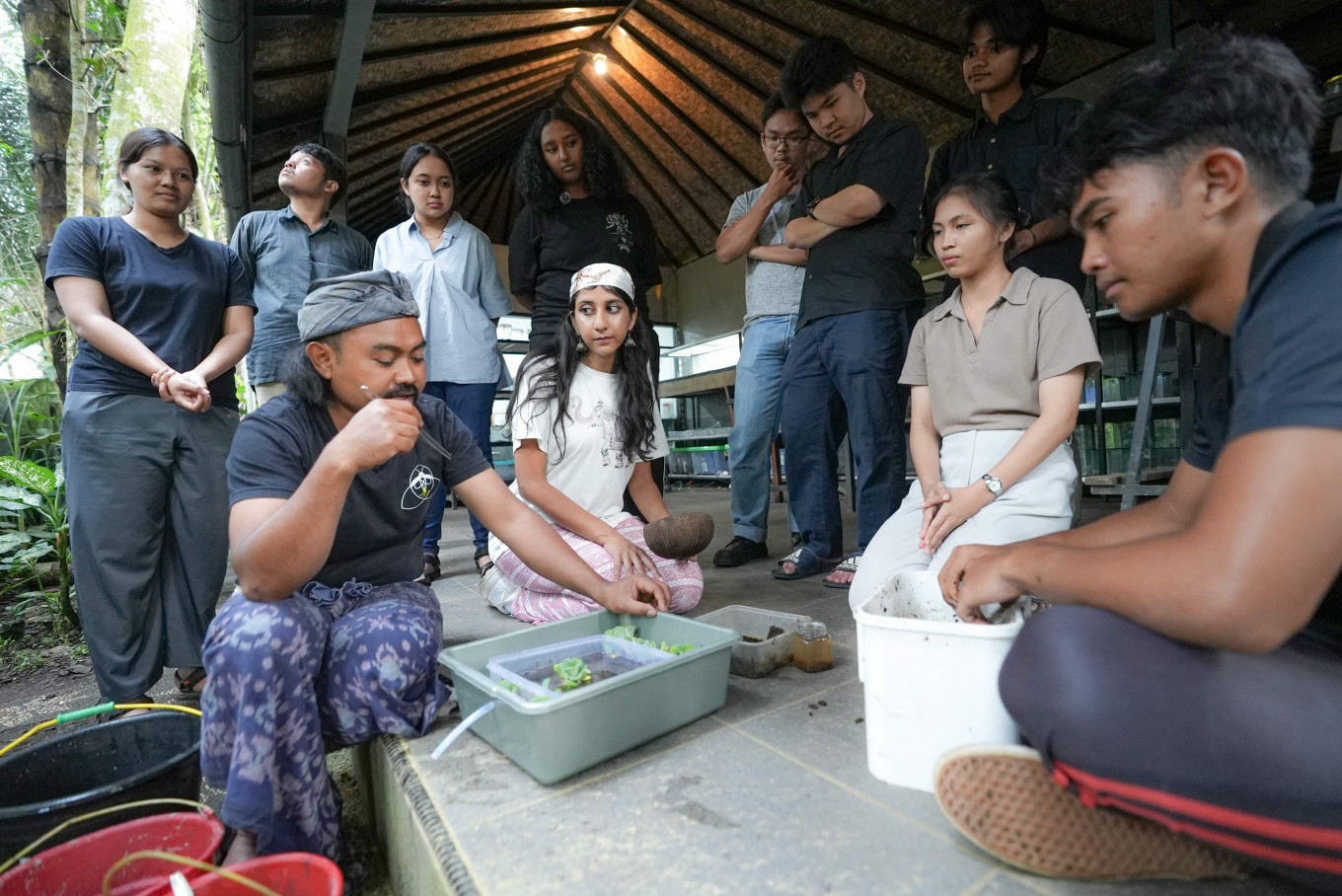
Inside, four young scientists hunched over trays, patiently feeding firefly larvae tiny snail eggs. Some volunteers help raise the larvae. Others spend the night catching wild fireflies to study their mating habits.
Like the journey to the center itself, one firefly’s life unfolds slowly. It begins as a delicate egg, hatches into a larva, then spends nearly two years feeding before becoming a cocoon.
“That’s what makes firefly conservation so challenging,” Wayan explained.
“The fireflies we see glowing live only 22 days, but it takes them up to two years to get there.”
He and his team have released over 5,500 fireflies back into the wild. But with such a long life cycle, the full impact of their work may take years to reveal itself.
Ecologically valuable, spiritually meaningful
The work is slow, but worth it.
These insects may be tiny, but their ecological and spiritual roles are outsized.
Fireflies are natural pest controllers, feeding on harmful snails and larvae in rice fields. They’re also bioindicators. When fireflies disappear, it means something is wrong.
“They are perceived as the nail of a deceased,” Wayan said.
“A reminder that we’ll die eventually, and our nail grows as a firefly.”
He recalled a belief passed down by his grandmother: “Never catch a firefly. Their presence means our ancestors are near.”
A personal mission
The scale of the center surprised me. It was vast, carefully maintained. Surely, this kind of work must cost a great deal. How did Wayan sustain it?
His answer caught me off guard. The land belonged to his parents. And as the owner of three businesses, waste management, organic farming consulting and ecotourism, he channels half of their revenue back into the center. What visitors pay for room and board helps fund research and operations.
Partly luck, part sacrifice, and mostly conviction and passion, Wayan’s enthusiasm was unmistakable. He moved with purpose.
“I want the visitors who come to our center to talk to others so they know that we exist,” Wayan said.
“All are welcome to create content about our center on their social media. I am grateful for that.”
Still, underneath his warmth, I could see his concern.
“Pesticides kill fireflies directly when they are in contact with them,” he said.
“The degradation of the land has decreased the level of biodiversity, damaging the ecosystem where fireflies live.”
A farmer himself, Wayan also teaches local farmers to reduce chemical use and switch to more sustainable practices. The center works closely with elementary schools and universities to educate students about ecology.
The return of the lights
As the sky dimmed, we gathered for dinner in the wooden hut. A few volunteers were visiting the center. One of them was Amrutha Tamerisa, 28, from London.
“I’ve seen fireflies in India and Africa, but seeing them in Bali is special,” Ammu said.
“This idea is amazing, and the center needs to be funded by the government.”
She hoped social media could keep the lights alive.
For many volunteers, the center offers not just a place to help but a space to reconnect.
Wayan said some people write to him weeks after leaving, saying they feel homesick for Taro village.
“They miss the frog sounds at night,” he smiled.
After dinner, Wayan led me back to the lab. When the first fireflies began glowing inside the incubator, something inside me jolted, like stepping into a time machine to my five-year-old self.
I stepped out to the rice field next. There weren’t many fireflies, but the few hovered freely in the dark. Hope, flickering in flashes.
As I prepared to return to the outside world, Ammu said something that stayed with me:
“Fireflies carry light. And it’s nice to have light in the world.”
“More fireflies also mean a cleaner world,” she added.
She was right. More fireflies mean something is healing. It means we’re walking on the right path.
I left the center with a full heart. The night taught me this: Light returns when we make space for it.
And in the quiet fields of Taro village, the world felt naturally bright again, even if only for a moment.
Handewi Pramesti is a freelance print and TV journalist based in Jakarta. She’s an avid traveler and outdoor enthusiast.