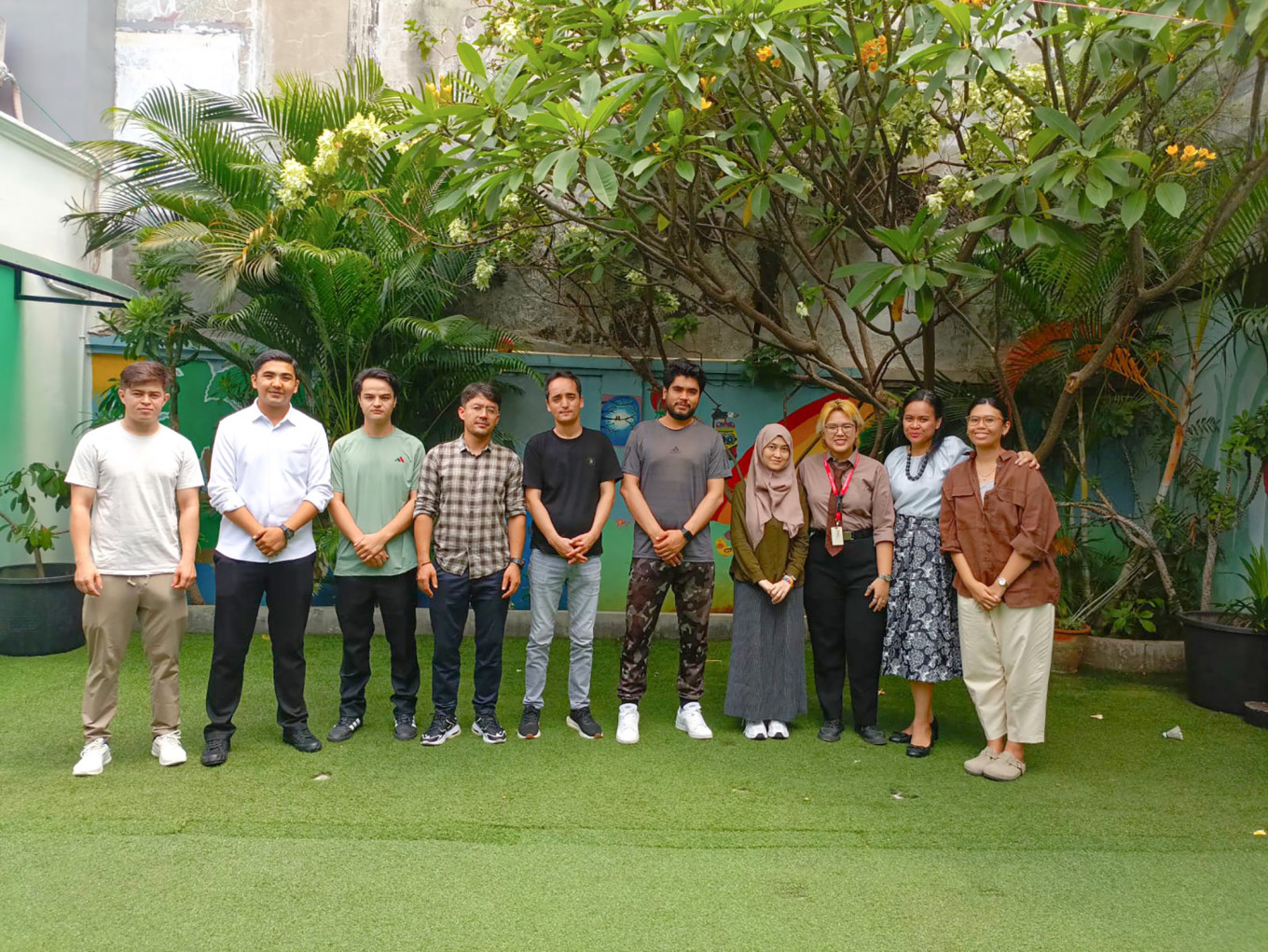
(Courtesy of Roshan Learning Center)
When I visited Roshan Learning Center in South Jakarta, lunchtime was almost over.
A group of eighth graders approached me with awkwardness and curiosity familiar to 14-year-olds everywhere. They asked about my work, laughed at each other’s jokes and debated everything from their last exam to math homework.
At that moment, they weren’t refugees; they were just teenagers.
Inside the classroom, their teacher, a young refugee himself, was setting up a presentation. The students teased him about the module. He teased them back. When he finally promised it would be an easy lesson, the room broke into cheers.
It felt like any other school: the noise, the teasing, the collective groan at the mention of homework. And when I slipped out of the room, they all turned and shouted, “Thank you!” in unison. Their bright smiles could melt even the grumpiest adult.
But Roshan Learning Center, run by Yayasan Internasional Cahaya Fajar (YICF), isn’t just any other school. It offers alternative education for children locked out of Indonesia’s public school system.

Thank you!
For signing up to our newsletter.
Please check your email for your newsletter subscription.
Here, kids in stateless limbo are given a chance at a future through education. They learn in English, using curricula from the United States, with a path to an internationally recognized diploma, even if Indonesia can’t issue one.
“Most of them want to be business owners and doctors because that’s what they know,” said Daisy Wardani, Roshan’s executive director.
“We host career days to expose them to different jobs.”
Many alumni return as volunteer teachers, like an Afghan graduate who now teaches math. Refugees teaching refugees, youth building a community from within.
A place to land
Indonesia currently shelters nearly 11,972 refugees and asylum seekers, according to UNHCR’s July 2025 report. Yet in Jakarta, you could easily go a day, or a lifetime, without realizing they’re here.
Local NGOs call the issue “niche”.
Only 735 out of roughly 3,000 school-aged refugee children are enrolled in accredited national schools as of August 2025, according to the UNHCR fact sheet. Documentation barriers, limited class space and language challenges keep most out.
Sure, Indonesia is a strategic transit point, not a final destination. But resettlement can take 10 to 15 years. With 29 percent of refugees under 17, many become adults before reaching their new home.
A decade in Indonesia can pass without a diploma, credentials or a formal place to learn.
Roshan Learning was created to meet that gap.
“We aim to provide a safe learning environment, because even though some have enrolled in public schools, many of them aren’t inclusive enough, and refugees can’t adapt to that,” Daisy said.
“If they aren’t educated sufficiently, there would be a disparity within their future generation.”
Since many students will resettle in the US, Canada, Australia or New Zealand, Roshan offers Elite Open School (EOS) and General Educational Development (GED) programs for seventh to 12th graders, preparing them for the standards for the countries they may eventually call home.
A space for adulting
But what happens when children grow up while resettlement still hasn’t come?
That’s where Bridges for Hope steps in, initially as a passion project.
Founder Marwah Aryantha started it after seeing a refugee friend struggle to find structured learning as an adult.
“The first class’ registrants were more than expected; we were only targeting five. It ended up with around 20 people,” she said.
“Long story short, we secured a grant and implemented the first batch of the refugee digital skills course.”
What began as a humble initiative grew into a nonprofit with a team of 25, offering digital literacy courses for refugees ages 18 to 25.
The curriculum is tailored: Marwah’s team runs baseline surveys to measure skill levels, interests and learning constraints. Weekend classes last three to four months and end with a modest graduation ceremony.
Next, Bridges for Hope plans to expand into entrepreneurship, arts and language, practical skills refugees can carry wherever and whenever they eventually settle.
A guiding beacon
These young people are more than their UNHCR case files, more than the statistics you should feel sorry for, more than the “stateless” labels often attached to them.
They are individuals with dreams, interests and families. And like all young people, they navigate life while carrying some struggles.
“Some have insomnia and depression,” Marwah said.
“It's not rare that we encounter some who struggle with even waking up and going to class because they couldn't sleep at night.”
Daisy echoed the weight they carry.
“It’s hard. Imagine leaving your country and family behind, settling in another country whose language you don’t even understand,” she said.
“Some of the children here arrived alone, so they learned how to cook and be independent. The same goes for the refugee teachers.”
They are resilient, yes, but resilience has limits. Solitude can hollow anyone out. That’s why these programs matter: not just for education, but for belonging.
“Many feel that these kinds of initiatives make them feel included and less alone,” Marwah said.
“It makes them much more hopeful.”
Daisy sees it daily: “They want to be better because Roshan has given them hope when they felt hopeless, so they don’t take education for granted.”
And that hope extends to the Indonesian volunteers who keep these programs running, often without recognition.
“You can always start small with the simplest things,” Marwah said.
“It’s a ripple effect because you can influence a friend who would pass the kindness to another friend, again and again. It could eventually be something huge in the end.”
In these small rooms with hand-me-down textbooks and teachers who understand because they’ve lived the same story, that ripple felt real.
I felt it the moment I entered that classroom. Maybe you will, too.
Siti Syafania Kose is a writer with a soft spot for art, history and all things humanities. They're a self-proclaimed nerd who accidentally became a gym jock, and now lives somewhere in between.