(Japan Film Festival)
Our obsession with Japanese culture, food, drinks, books, has always been vast. How can we not be? Japanese products are prized for their quality and intention, and Japanese films are no exception. From Studio Ghibli to Doraemon, their storytelling stretches easily across emotions, often balancing warmth with melancholy.
In 2025, the Japanese Film Festival (JFF) returned for its biggest iteration yet. Running since 2016, the festival expanded to nine cities across Indonesia, screening 15 films between Nov. 6 and Dec. 21. I visited the Jakarta leg and watched a handful of films that reaffirmed why Japanese cinema travels so well across borders.
So what exactly makes Japanese cinema feel so emotionally specific, yet universally familiar? Some of the answers lie in contrast. Japanese movies move fluidly between spectacle and stillness, between philosophical abstraction and ordinary lives. It’s the restraint, the subtleness and calm, that invites the audience to reflect.
The festival may be over, but the films are not out of reach. Because of the massive response to the festival, JFF is hosting an encore event on Jan. 24, 2026, at Grand Indonesia, Central Jakarta.
Moreover, The Japan Foundation, which organizes JFF, runs JFF Theater, a legal streaming platform featuring a rotating selection of classic and contemporary Japanese films, updated quarterly. And if they’re not there, most are available on the usual video-on-demand platforms.
Here are five movies I curated, grouped not by genre, but by mood.
- If you crave a cyberpunk world: Ghost in the Shell

Thank you!
For signing up to our newsletter.
Please check your email for your newsletter subscription.
If you like Blade Runner and everything cyberpunk, Ghost in the Shell, directed by Mamoru Oshii, is essential viewing.
A landmark anime action thriller, it’s often mentioned in the same breath as Akira. Both imagine dystopian futures that have profoundly shaped global pop culture. Since its release, it has earned its place as one of the most influential science-fiction films of all time.
And yes, it really is that good. Even three decades later, the cinematography remains breathtaking. Nearly every frame feels like a complete sci-fi artwork, balancing grime, beauty and scale.
 . (Japan Film Festival)
But beyond the visuals, the film’s magnetic pull is philosophical: What makes a human human? In a world where consciousness can be transferred into superpowered androids, identity itself becomes unstable.
The plot unfolds like a layered noir mystery, spiraling into an anxiety-inducing conspiracy that lingers long after the credits roll. Stylish, cerebral and rewatchable, Ghost in the Shell isn’t just a classic, it’s a rite of passage.
- If you are a romantic who loves a killer soundtrack: Linda Linda Linda
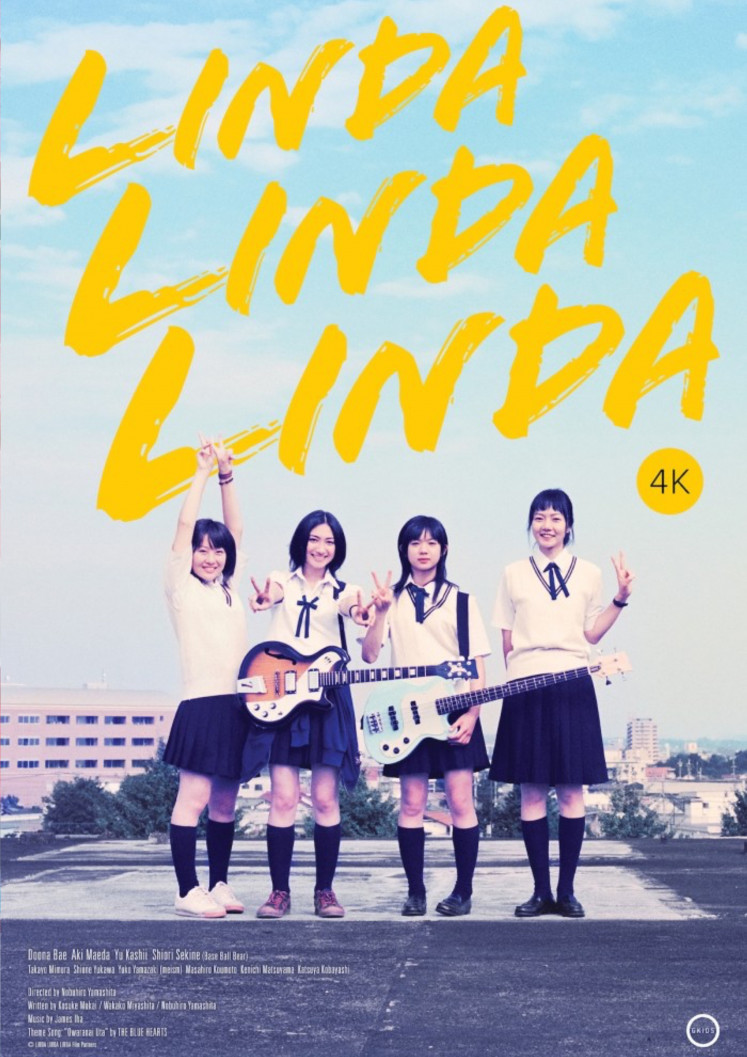
If you’re looking for melancholic nostalgia, Linda Linda Linda is a gentle crowd-pleaser that makes you laugh at, and miss, your younger self.
The film follows four high school girls forming a band for their school’s summer festival, capturing the awkwardness, boredom and joy of being a teenager. From timid love confessions to staying out far too late, it plays like a time capsule of youth.
Directed by Nobuhiro Yamashita, Linda Linda Linda keeps its plot deliberately simple: practice, perform, repeat. But the heart of the film is in the small, silly moments of friendships that feel impossible to replicate once you grow up.
 . (Japan Film Festival)
The soundtrack, composed by James Iha of The Smashing Pumpkins, also features songs by beloved Japanese punk bands, making the film as memorable sonically as it is emotionally.
First released in 2005, the film recently celebrated its 20th anniversary with a 4K digital remaster. If you haven’t seen it, now is the perfect time.
- If you love a clever heist: Angry Squad: The Civil Servant and the Seven Swindlers
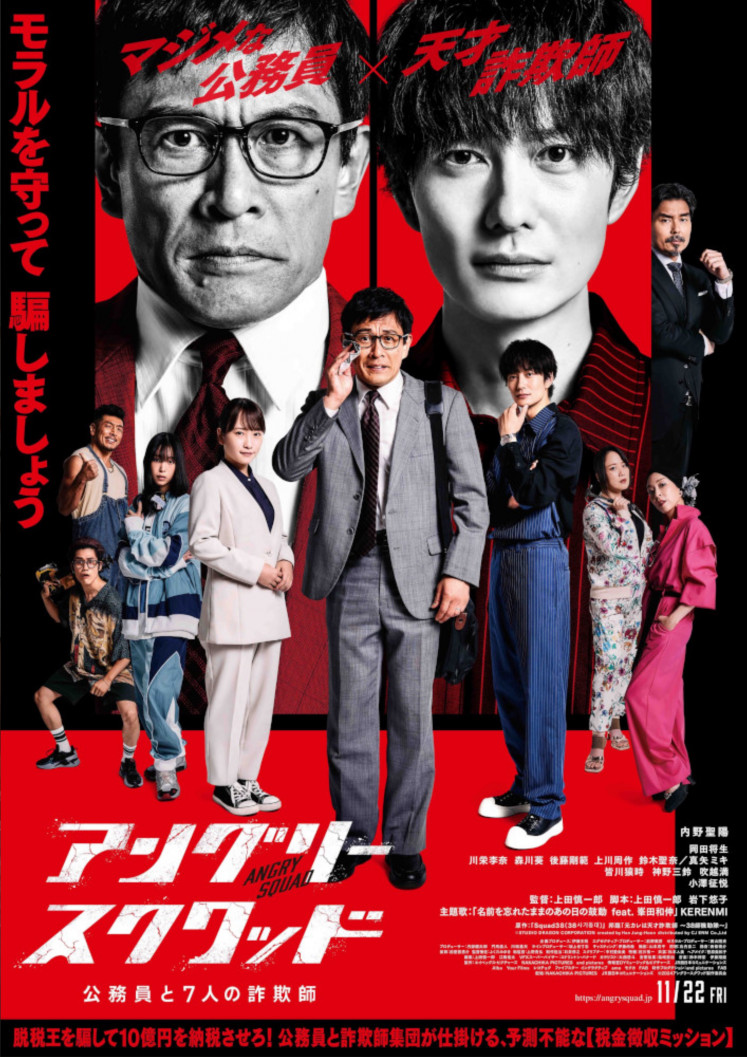
I love it when a plan comes together, especially when it's a clean con. There’s something deeply satisfying about a heist that feels earned, and Angry Squad delivers exactly that.
The film flips the genre by centering not on the criminals, but on a civil servant who collects taxes from the corrupt. It’s a clever spin on the Robin Hood trope, stealing not for profit, but for accountability.
The genre’s typical beats are all here: assembling a mismatched crew, near-disasters and a mischievous plan that can collapse at any moment. The moral twist is the target: not vault or diamonds, but a mega-corporation hiding tax evasion.
 . (Japan Film Festival)
Released in November 2024, Angry Squad anchors its spectacle with high emotional stakes. The director, Shin’ichirô Ueda, gives each character a reason to risk everything. The result is gripping, a sharply paced film that balances tension with a clever, cathartic payoff.
- If you want to escape reality: Sunset Sunrise
As the festival’s opening film, Sunset Sunrise set the bar stunningly high. Directed by Yoshiyuki Kishi, the film is set in 2020 and follows Nishio, a Tokyo salaryman who relocates to a rural coastal town. His pace of life has been altered by the new normal of remote work.
What begins as a practical decision slowly turns intentional and existential.
I went in with zero expectations and left in awe. The film’s deliberate pacing allows its setting to breathe, drawing you to the rhythms of village life and its people.
 . (Japan Film Festival)
A slow burn by design, Sunset Sunrise uses stillness and picturesque scenes to explore connection, purpose and belonging. The space it gives its characters forces us to sit with our own vulnerability. By the end, it’s impossible not to feel attached to the town and the characters.
- If you like your fun with facts: Cells at Work!
A fun ride for the whole family, Cells at Work! turns education into spectacle. Released in 2024, the film delivers an inspired concept executed with infectious energy.
Equal parts action-comedy and biology lesson, the film anthropomorphizes the human body: red blood cells become couriers, white blood cells transform into frontline defenders. Veins turn into subway systems, lungs into factories and coughing into rocket launches.
 . (Japan Film Festival)
It’s surprisingly educational without ever feeling instructional, disguising science as world-building rather than exposition.
Silly, inventive and genuinely engaging, Cells at Work!, directed by Hideki Takeuchi, proves that learning when done right can be just as thrilling as any blockbuster.
Aqraa Sagir is a writer for The Jakarta Post's Creative Desk. He’s chronically online in the hope it would be a useful asset for the job.